
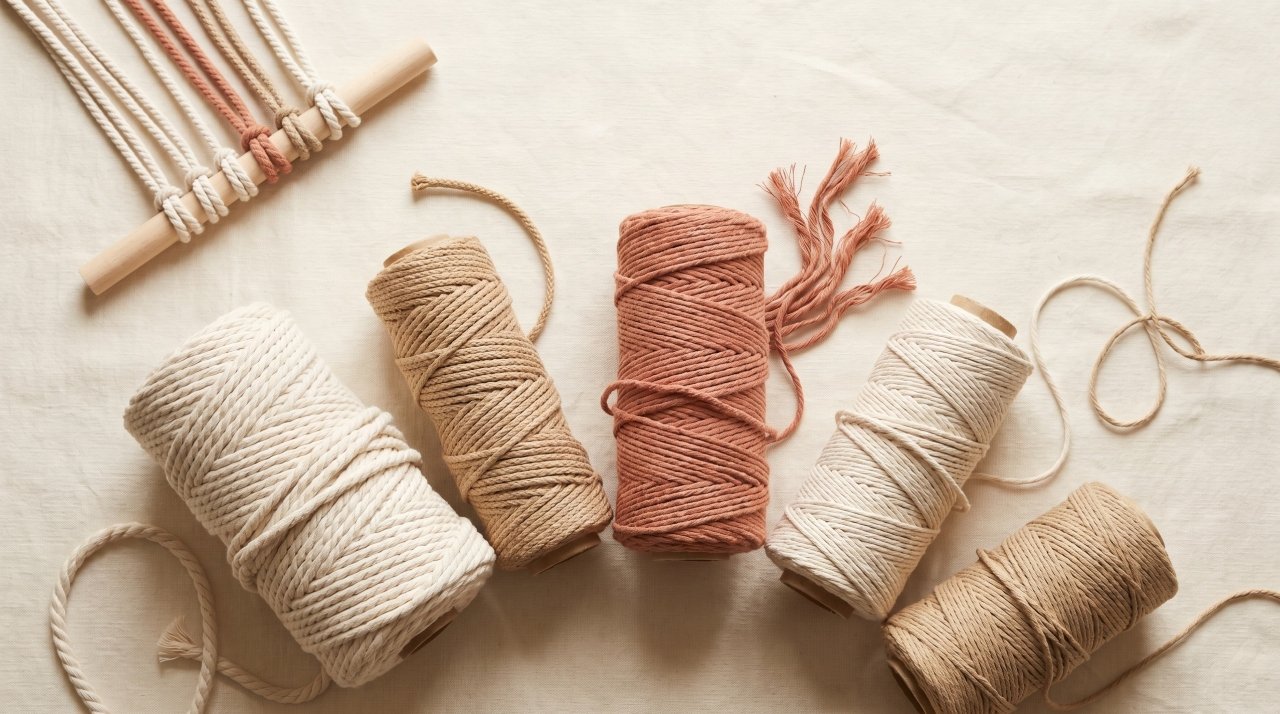
Most guides online give you a list of products and call it a day. This one works differently. You’ll walk away knowing exactly which cord type matches your project and skill level — with the thickness, material, and quantity figured out — before you spend a dollar.
The short answer, if you need it right now: a 3mm or 4mm single-twist 100% cotton cord is the best macrame cord for most wall hangings. But whether that’s right for your wall hanging depends on three things. Keep reading to find out.
Before you buy anything, it helps to know which macrame knots you’ll be tying — because knot density directly affects how much cord you need.
The Honest Answer Upfront
There is no single “best” macrame cord for all wall hangings. That sounds unhelpful, but it protects you from buying the wrong thing. The right cord comes down to three variables: the style of twist, the thickness in millimeters, and the fiber material. Get all three right and your project looks exactly like what you pictured. Get one wrong and you’ll fight the cord the entire time.
Here’s what nobody tells you upfront: the cord type that looks most beautiful in finished photos — that soft, cloud-like fringe — is also the trickiest to work with. It unravels aggressively, punishes uneven tension, and makes mistakes harder to undo. If you’re a beginner, choosing it without knowing that will turn a fun Sunday project into a frustrating one.
The 3 Cord Types Compared
Every macrame cord you’ll find falls into one of three categories. The difference between them is structural, and it affects everything: how knots look, how easy the cord is to work with, and what the finished fringe looks like.
This cord is made from many fine threads all twisted together into a single strand. It’s the softest of the three types, and it creates that dreamy, brushed-out fringe you see in Instagram-worthy wall hangings. When you unravel the end and brush it, it fans into a beautiful cloud of soft fibers.
The trade-off is that it unravels quickly — which is exactly what makes it ideal for fringe, but also what makes it punishing when you’re re-tying knots repeatedly. If you don’t have consistent tension yet, this cord will show it.
Three individual strands are twisted together to form one rope. This is the most popular macrame cord sold online, and for good reason — it’s sturdy, holds its shape during knotting, and is much more forgiving when you undo and redo sections. The twist gives knots a satisfying, defined look.
It frays and brushes out well, though it takes a bit more effort than single-twist. It works for wall hangings of any size and is a strong choice if you’re still building consistency in your tension. You’ll find it in sizes from 3mm up to 20mm.
Multiple strands woven together in an interlocking braid. This cord is extremely durable, resists unraveling, and is easy to wash — making it the go-to for placemats, coasters, rugs, and bags. It also handles dyeing extremely well and holds color vibrantly.
For wall hangings, though, it has a real limitation: it doesn’t fray into soft, wispy fringe. When you cut or unravel the end, you get a flat, stiff edge rather than the feathery finish most wall hanging designs call for. It also comes mainly in 3mm and 5mm.
Pro TipYou can mix cord types in a single wall hanging for texture contrast — use 3-ply for the main knotted body and single-twist for accent sections or the bottom fringe. Just keep both at the same thickness for consistent tension.
Which Thickness Is Right for You
Cord thickness is measured in millimeters (mm), and it’s the variable most beginners get wrong. Going too thin on a large piece creates a fiddly, fragile result that lacks visual presence on a wall. Going too thick on a small piece produces chunky, crowded knots that lose their definition.
Here’s how to match thickness to your project:
3mm — The All-Rounder
This is the most widely used size for wall hangings, and it earns that spot. It’s fine enough to show intricate knot patterns clearly, yet sturdy enough that a beginner can control it without constant frustration. For most first and second wall hangings in the 30–60cm range, 3mm cotton is the correct choice. If you only buy one size to start, make it 3mm.
4mm — The Beginner’s Best Friend
Slightly chunkier than 3mm, which means it works up faster and feels easier in your hands before your fingers have built up muscle memory. Many instructors recommend starting at 4mm because you can see and feel each knot clearly, and mistakes are easier to identify and fix. For wall hangings above 45cm wide, 4mm also gives the piece better visual weight.
5mm — Larger Pieces and Statement Walls
Once you’re making wall hangings wider than 60cm, or you want that bold, textural boho look where the cord itself is part of the visual story, 5mm comes into its own. It works up quickly, creates fuller fringe, and makes a real statement from across a room. It’s harder to do intricate geometric patterns at this size, but for organic and flowing designs it’s excellent.
6mm and Above — Large Installations Only
Use 6mm–10mm for large-format wall installations over 90cm wide. At this scale, thinner cord looks thin and insubstantial. Be aware that thick cord adds significant weight to a finished piece — a large 8mm wall hanging can be surprisingly heavy, so factor in your mounting hardware.
Cotton vs. Recycled Cotton vs. Alternatives
The overwhelming majority of macrame cord for wall hangings is cotton — and that’s the right call. Cotton is soft on your hands during long knotting sessions, holds knots well without slipping, brushes out beautifully for fringe, and is available in every color imaginable. It’s also forgiving when you need to undo work.
100% natural cotton is the standard. It’s soft, widely available, and consistent in quality across reputable brands. It tends to be slightly less firm than recycled cotton, which can be either a pro or con depending on your preference.
Recycled cotton is made from post-industrial cotton waste and is increasingly the preferred choice among fiber artists who care about sustainability. In practice, the working feel is slightly stiffer than virgin cotton — your knots will look marginally crisper and more defined. It also holds color a bit better. If you have the choice, recycled cotton is a genuinely good upgrade, not just a marketing claim.
Hemp is worth considering for wall hangings with a rougher, more rustic aesthetic — think earthy, outdoor, or botanical-style pieces. It’s stronger than cotton and has a natural, slightly rough texture that gives knots a very different look. It’s not great for brushed fringe though, and it’s harder on your hands during long sessions.
Bamboo is a newer option with a beautifully silky feel and a natural sheen. It works well for modern, refined wall hangings where you want clean lines over fluffy texture. It’s harder to find in a wide range of colors, and more expensive.
Avoid nylon, polyester, and wax-coated cords for wall hangings. They don’t fray in the way most wall hanging designs require, and the slick surface makes knot tension harder to control — especially if you’re still building your technique.
Quick Comparison Table
| Cord Type | Wall Hanging Suitability | Fringe Quality | Beginner-Friendly | Best Size |
|---|---|---|---|---|
| Single-Twist Cotton Best for Fringe | Excellent | ⭐⭐⭐⭐⭐ Soft & wispy | Moderate | 3mm–5mm |
| 3-Ply Twisted Cotton Most Versatile | Excellent | ⭐⭐⭐⭐ Good with effort | High | 3mm–6mm |
| Braided Cotton | Limited | ⭐⭐ Stiff edges | High | 3mm–5mm |
| Hemp | Good (rustic) | ⭐⭐⭐ Rough texture | Moderate | 3mm–5mm |
| Recycled Cotton | Excellent | ⭐⭐⭐⭐⭐ Crisp & full | Moderate–High | 3mm–5mm |
| Bamboo | Good (modern) | ⭐⭐⭐ Smooth & clean | Low–Moderate | 2mm–4mm |
How Much Cord You Actually Need
This is the question every guide glosses over, leaving you with either a pile of leftover cord or — far worse — running out six rows from the bottom. Here’s how to calculate it before you buy.
The standard rule: cut each cord to four times the finished length of your wall hanging. Because most wall hanging cords are folded in half at the dowel using a lark’s head knot, that means each cut length should be eight times the finished length of the piece.
For example, if you want a wall hanging that’s 50cm (about 20 inches) long from dowel to bottom fringe, cut each cord to 400cm (about 157 inches, or just over 4 yards). That gives you working length plus fringe.
Adjust for knot density: if your pattern is very dense with tight square knots across the full width, add another 15–20% to your estimate. Dense knotwork consumes cord faster than open, airy designs with plenty of negative space.
Cut length per cord = finished wall hanging length × 8
Total cord needed = cut length × number of cords
Add 20% buffer for dense patterns, or if you’re new and expect to undo knots.
If you want to go deeper on the math before cutting, this guide on how to estimate macrame cord length covers pattern-specific variables in detail.
A typical beginner wall hanging about 50cm × 40cm uses roughly 40–60 meters of 3mm cord. A standard 100m spool will cover it comfortably. For larger or denser pieces, estimate 150–200m and buy accordingly — running out mid-project with a dye lot you can’t match is genuinely maddening.
The 3 Mistakes Beginners Make When Choosing Cord
These aren’t obscure pitfalls. They’re what trips up nearly every person making their first or second wall hanging, and knowing them upfront saves real money and frustration.
1. Choosing the prettiest cord instead of the right cord
Single-twist cord looks gorgeous finished — that’s why it’s in every photo. But if you’re still building even tension, it will punish you. Every uneven knot shows more clearly on single-twist than on 3-ply. Start with 3-ply twisted cotton for your first two or three pieces to develop consistency, then switch to single-twist when you’re ready for the challenge.
2. Going too thin for the piece size
Beginners often assume that thinner cord means more delicate and beautiful. On a large wall hanging, 2mm cord just disappears visually and the whole piece looks wispy and underwhelming in person. For any wall hanging wider than 30cm, you want at least 3mm. Anything statement-sized needs 4mm or 5mm to read properly from across a room.
3. Underestimating how much cord to buy
The math above seems like a lot of cord — and it is. Macrame consumes cord at a rate that shocks most newcomers. A wall hanging that looks 30cm long uses far more cord than 30cm per strand, because every knot takes cord from multiple directions. Always buy 20% more than your estimate, and keep the receipt in case you don’t need it. Running short before you finish the fringe is deflating in a way that’s hard to recover from.
Recommended Brands and Where to Buy
You don’t need to be brand-loyal in macrame. What matters is consistent diameter, consistent quality between spools, and softness that’s easy on your hands. That said, a few names come up repeatedly in fiber arts communities for good reasons.
Bobbiny is the most recommended premium brand for serious macrame work. Based in Poland, Their cord is OEKO-TEX certified, made from 100% recycled cotton with extremely consistent diameter — independent measurements show variance of less than ±0.1mm across spools, which matters when you want uniform knots across a large piece. Available in an exceptional range of colors. It’s more expensive than craft store options, but worth it for finished pieces you’re proud to hang or sell.
Nook Theory offers quality 3mm twisted cotton at a reasonable price point, with a good color range and reliable consistency. It’s widely recommended for beginners who want quality without premium pricing.
Craft store house brands (from stores like Michael’s, JOANN, or Hobbycraft in the UK) work fine for practice and first projects. The quality varies more between batches, but the price is forgiving when you’re still figuring out how much cord you actually use.
For sourcing, Amazon is convenient and you can find solid options across all price points — just check that the listing specifies the material (100% cotton, not “cotton blend”) and read reviews specifically mentioning wall hangings rather than keychains or jewelry, since those use cord very differently. Specialty fiber arts suppliers online tend to have better quality control and more color options than mass-market listings.
If you can buy cord in person, run 30cm of it through your fingers and gently pull the end apart. Good wall hanging cord should fray softly without shedding fibers excessively. If it pills or sheds a lot, it will do the same thing while you’re knotting.
The One Rule to Remember
If you close this guide and remember only one thing, make it this: match your cord to the size of your project and the finish you want — not to what looks prettiest in someone else’s finished photo.
For a first wall hanging: 4mm 3-ply cotton, natural or recycled, from a reputable brand. Cut it longer than you think you need. The forgiveness of 3-ply will let you actually finish the piece instead of wrestling with it.
Once you’re three or four pieces in and your tension is consistent: move to 3mm single-twist cotton for that soft, luxurious fringe look. That’s when the challenge of the cord becomes a pleasure rather than an obstacle.
The cord is only one part of what makes a wall hanging beautiful. Your tension, your pattern choices, and your willingness to undo and redo sections matter just as much. But starting with the right cord means you spend your energy on the craft — not fighting the material.
Happy knotting.
Ready to Start Your Wall Hanging?
Once you’ve chosen your cord, the next step is planning your knot pattern. Check out our beginner wall hanging patterns — each one lists the exact cord type, thickness, and quantity you’ll need.

