
As an Amazon Associate I earn from qualifying purchases.
A single macrame curtain for a standard doorway can use over 500 feet of cord — and most beginners don’t find that out until they’re already halfway through the project. That’s the kind of surprise that turns an exciting weekend craft into a frustrating trip back to the craft store.
You’re not alone if you’ve made a few plant hangers or bracelets and now you’re staring at a doorway thinking, “Can I actually pull that off?” The honest answer is yes — but only if you go in with the right information. This guide gives you everything you need: how much cord to buy, which knots work at scale, how long it realistically takes, and exactly how to hang the finished piece.
What Are Macrame Curtains?
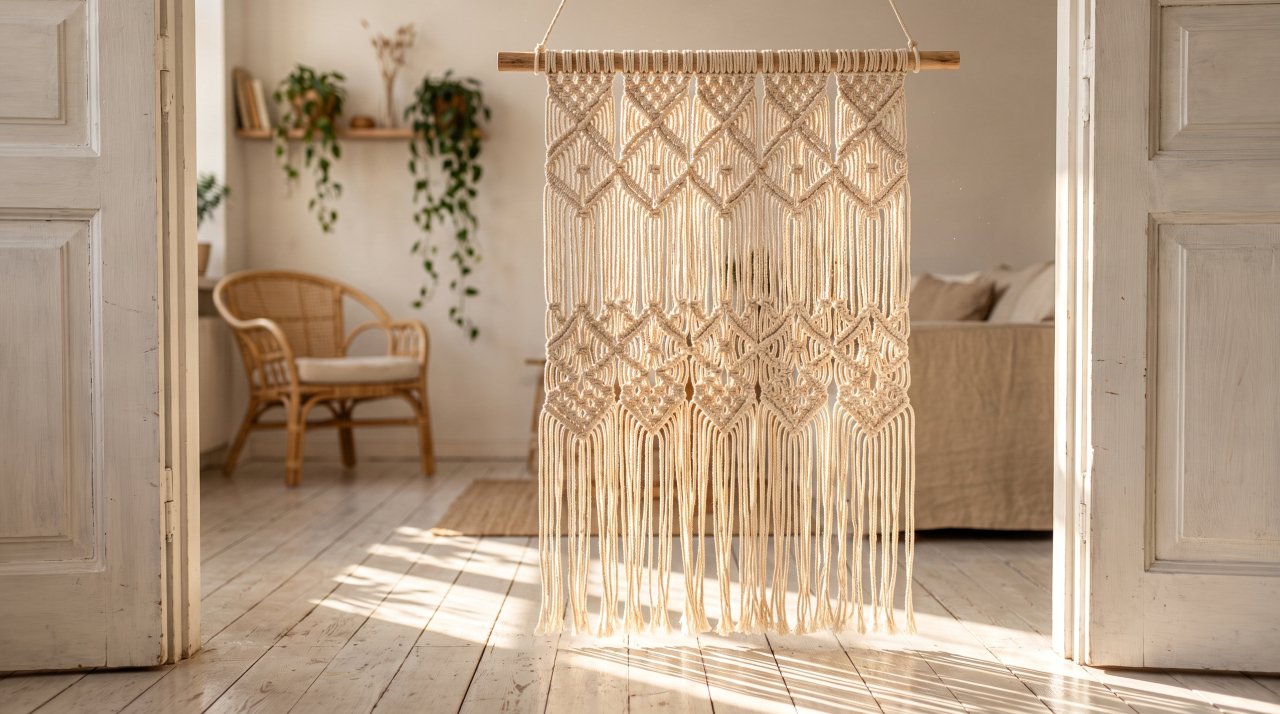
Macrame curtains are large-format textile panels made by knotting cord in repeating patterns. You hang them in doorways, across windows, or between rooms as boho-style room dividers.
They differ from wall hangings in one key way: size. A wall hanging might use 50–100 feet of cord. A doorway curtain? Easily 400–600 feet, depending on density and length. That scale change is what trips up most beginners — not the knots themselves.
The good news is that most macrame curtains use only 2–3 basic knots. If you can tie a square knot and a half hitch, you already have the core skill set.
Types of Macrame Curtains (And What Each One Needs)
Not all macrame curtains are the same project. Your approach changes significantly depending on where the curtain goes.
Doorway curtains are the most common type. A standard interior doorway runs 32–36 inches wide and 80 inches tall. You’ll need enough strands to cover that width with consistent spacing — typically one strand every 0.5–1 inch.
Window curtains are smaller and often more decorative. A standard window might be 24–36 inches wide, which cuts your cord requirement considerably. These make great starter projects before you tackle a full doorway.
Room dividers are the most ambitious option. They span wider openings — sometimes 6–8 feet — and need a heavy-duty dowel or metal rod to hold the weight. Plan on doubling your cord estimate and your time.
How Much Cord Do You Actually Need?
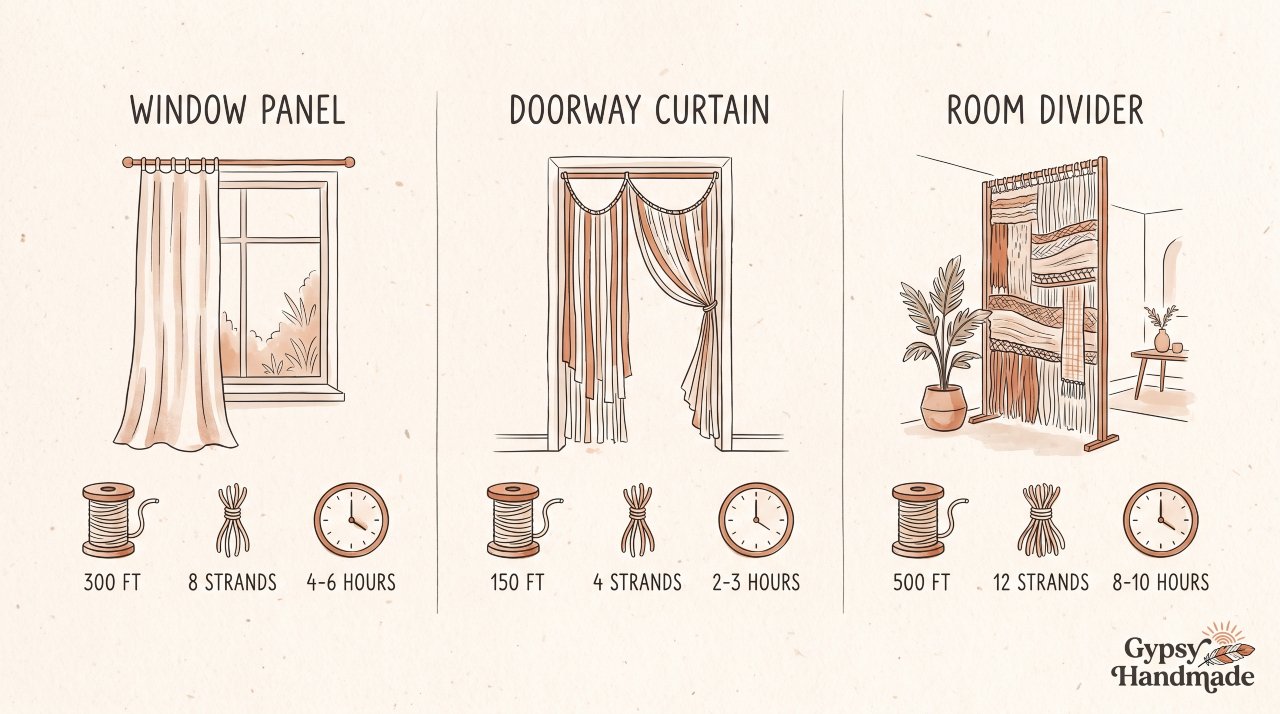
This is the question every tutorial skips, and it’s the most important one. Here’s the formula:
Each strand of cord should be cut to 4× the finished length of your curtain. For a curtain 72 inches (6 feet) long, each strand starts at 288 inches — that’s 24 feet per strand, before you account for knot density.
Use this quick-reference table to estimate your total cord:
| Curtain Type | Finished Width | Finished Length | Strands Needed | Estimated Total Cord |
|---|---|---|---|---|
| Window panel | 24 inches | 36 inches | 48–60 strands | 200–250 ft |
| Doorway curtain | 36 inches | 72 inches | 72–90 strands | 450–600 ft |
| Room divider | 72 inches | 80 inches | 140–180 strands | 900–1,200 ft |
These figures assume a medium-density spiral or square knot pattern with 0.5-inch strand spacing. Add 15–20% extra if you’re using a dense pattern like the alternating square knot grid, which consumes cord faster. Buy more than you think you need — running out mid-project means colour-matching a new batch, and that’s a headache you don’t want.
For cord type, a 3mm single-strand cotton cord works well for most curtain projects. It’s soft, holds knots cleanly, and fringes beautifully at the bottom. Check out the guide to best macrame cord for beginners to compare cotton, jute, and nylon before you buy.
The 3 Knots That Build Most Macrame Curtains
You don’t need to know 20 knots. You need to know three, and know them well.
1. The Lark’s Head Knot — This is how you attach every strand to your dowel. Fold a strand in half, loop it over the rod, and pull both ends through the loop. That’s it. Every curtain starts here.
2. The Square Knot — This is your workhorse. Two outer cords cross over two inner cords, then reverse. Repeated across a row, it creates the classic macrame grid pattern. Alternating square knots (offset by half a repeat on each row) create the diamond or mesh look you’ve seen in most boho curtains.
3. The Half Hitch / Spiral Knot — A half hitch repeated on the same side creates a spiral. It’s fast, it looks impressive, and it fills vertical space quickly. Great for filling in sections between pattern areas.
That’s genuinely all you need for a full doorway curtain. The complexity in large-format pieces comes from repeating these knots consistently — not from learning advanced techniques.
How to Keep Your Pattern Even at Scale
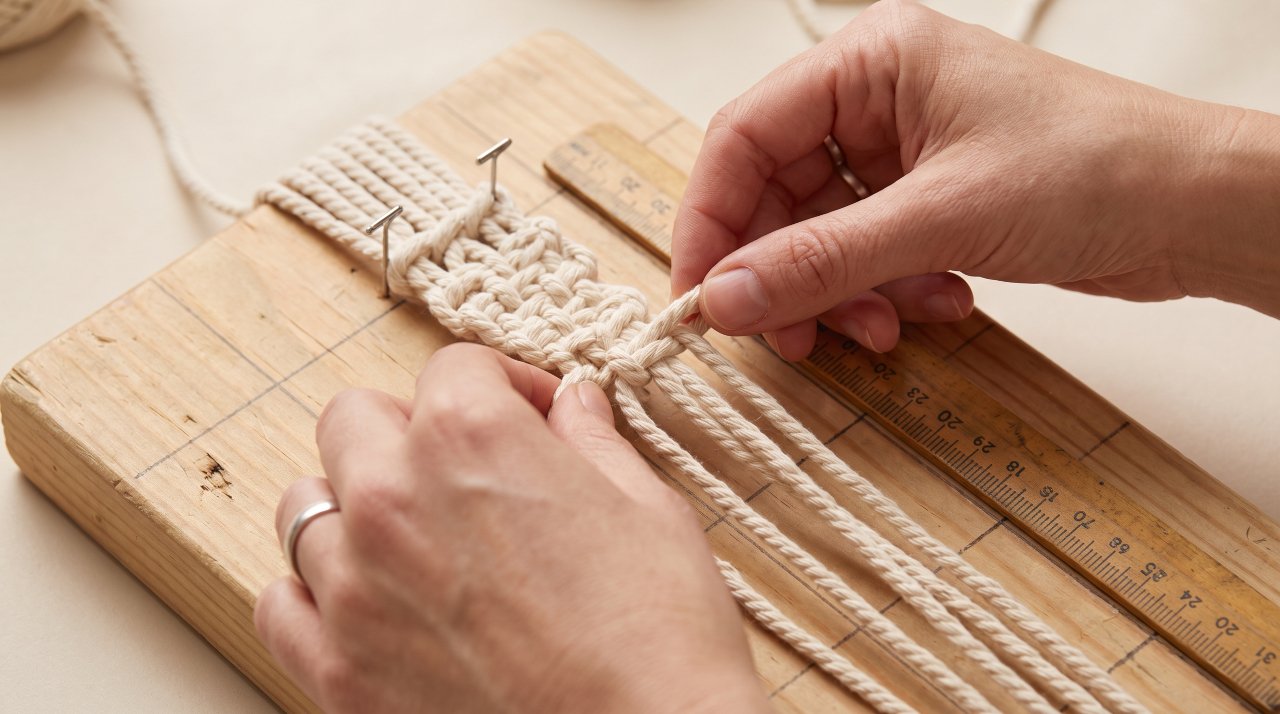
This is where most beginners struggle when scaling up. A pattern that looked perfect on a small wall hanging starts to drift, uneven and lopsided, halfway down a 6-foot curtain.
The fix is simple: work in horizontal sections, not vertical columns. Tie one complete horizontal row of knots across all your strands before moving to the next row. This keeps tension consistent across the full width.
Use a measuring tape every 4–6 rows to check that your knot rows sit at the same height across the curtain. If one section drifts lower, you’ve let the cord tension loosen. Retighten by pushing the knots upward gently with your finger before they set.
Pin your working strands to a foam board or macrame board while you work. According to Craft Yarn Council guidelines on fibre crafts, consistent tension is the single most important skill for producing even results in large knotted textile projects. Tension is everything.
Beginner-Friendly Macrame Curtain Patterns
Pattern 1: Alternating Square Knot Mesh
This is the most beginner-friendly curtain pattern and the most forgiving at scale. Tie rows of square knots, offsetting each row by one knot position. The result is an open diamond mesh — airy, boho, and forgiving of minor tension inconsistencies.
Pattern 2: Vertical Spiral Sections
Group your strands into sets of 4 and work spiral knots down each group. This creates a curtain that looks like twisted columns — great for doorways because it has a natural flow when pushed aside.
Pattern 3: Simple Fringe Panel
The easiest option of all. Attach strands to a dowel using lark’s head knots, tie one row of square knots near the top for structure, then leave the rest as long fringe. It’s fast, it works, and it looks genuinely beautiful. A 36-inch doorway curtain in this style takes 3–4 hours start to finish.
For a step-by-step introduction to working with knots and pattern repeats, the macrame rainbow wall hanging tutorial is a great confidence-builder before you scale up to a full curtain.
How Long Does a Macrame Curtain Take?
Here’s the honest answer most guides won’t give you.
A simple fringe panel for a doorway takes 3–5 hours for a beginner. An alternating square knot mesh at the same size takes 12–20 hours across multiple sessions. A dense pattern room divider can take 30–40+ hours.
That’s not meant to scare you. It’s meant to help you plan. Working in 1–2 hour sessions spread across two weekends is completely realistic for a doorway curtain with a medium-density pattern.
Don’t try to rush a large-format piece in one sitting. Your tension gets worse as your hands tire, and the bottom third of the curtain will look noticeably different from the top.
What You’ll Need: Tools and Supplies
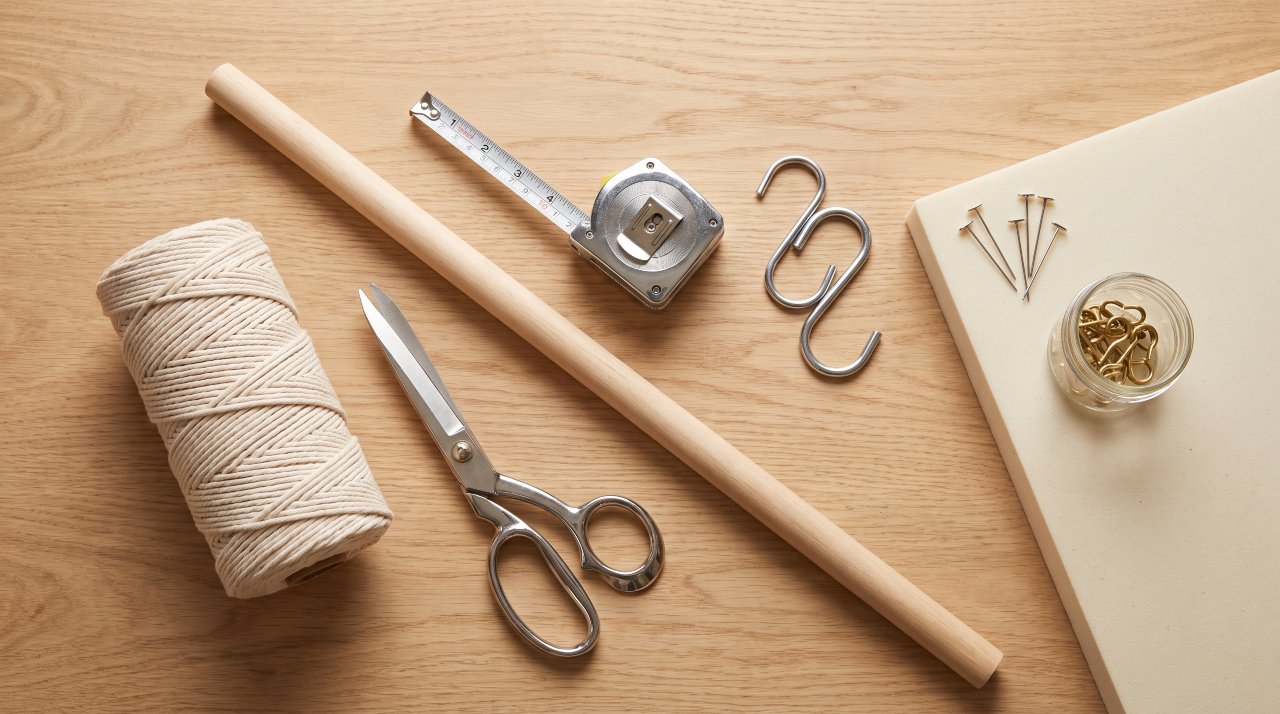
You don’t need much, but what you use matters at this scale.
- Dowel or rod: A 36-inch wooden dowel (1-inch diameter) holds a doorway curtain easily. For room dividers, use a metal curtain rod or copper pipe — they won’t bow under the weight.
- Cotton macrame cord: 3mm single-strand cotton is the standard choice for curtains. Pick up at least 20% more than your estimate.
- Scissors: Sharp fabric scissors, not craft scissors. Long cutting sessions with dull blades will wreck your wrists.
- Measuring tape: Essential for checking row consistency.
- Macrame board or foam board: Not optional for a large piece. You need somewhere to pin and anchor your work.
- S-hooks or ceiling hooks: For hanging your dowel while you work — frees both hands.
Before you buy everything at once, the guide to essential macrame supplies for beginners covers exactly what’s worth buying and what you can skip.
How to Hang a Macrame Curtain
Hanging is simpler than most people expect. The dowel carries the full weight, so your hanging method just needs to support the rod.
For a doorway: Use two ceiling hooks screwed into the door frame header (the horizontal beam above the door). Run twine, leather cord, or S-hooks from the hooks to the ends of your dowel. Keep the curtain 1–2 inches above the floor so it flows naturally when someone walks through.
For a window: A tension rod inside the window frame works perfectly. No drilling, no damage, and easy to remove. Slide lark’s head loops directly onto the tension rod before you start knotting — this integrates the hanging method into the curtain itself.
For a room divider: Use a ceiling-mounted curtain track for maximum stability. According to This Old House’s guide to curtain hardware, ceiling-mounted tracks support significantly more weight than wall brackets and give you a cleaner look for open-plan spaces.
Buying vs. Making: An Honest Comparison
Making your own macrame curtain costs roughly $25–$60 in materials for a doorway panel, depending on cord quality and density. A comparable handmade curtain on Etsy runs $80–$250+ for the same size.
The trade-off is time. If your time is genuinely worth more than $10–15/hour, buying might make more sense. If you enjoy the process — and most people who are reading this guide do — making your own is deeply satisfying.
One downside worth mentioning: hand-knotted macrame curtains are not easy to clean. Spot-cleaning with a damp cloth works for most marks. Machine washing a large knotted panel risks tangling and distorting the knots permanently. Factor that into your decision, especially if the curtain is going in a kitchen or near a cooking area.
For style inspiration and quality benchmarks, browsing Etsy’s handmade macrame curtain listings is genuinely useful — you can see what professional makers charge and what finished pieces look like before you commit to a pattern.
FAQ: Macrame Curtains
How much cord do I need for a macrame curtain?
For a standard doorway curtain (36 inches wide, 72 inches long), plan on 450–600 feet of 3mm cotton cord. Cut each strand to 4× your finished curtain length, then multiply by the number of strands. Always buy 15–20% extra to account for knot density and fringe.
Are macrame curtains easy to make?
A simple fringe or spiral-column curtain is very manageable for beginners — especially if you’ve already completed smaller projects. A dense alternating square knot pattern is more challenging at scale, mostly because of tension management over a wide piece, not knot complexity.
What kind of cord is used for macrame curtains?
3mm single-strand cotton cord is the most popular choice. It’s soft, drapes well, fringes beautifully, and holds knots without slipping. Jute works for a more rustic look but is rougher to handle. Avoid nylon for curtains — it doesn’t have the right drape or texture for large panels.
How do you hang a macrame curtain in a doorway?
Screw two ceiling hooks into the door frame header, one at each end. Hang your dowel from those hooks using cord, leather strips, or S-hooks. Position the curtain so the bottom sits 1–2 inches above the floor for a clean look.
Can macrame curtains work as room dividers?
Yes — and they’re one of the most popular boho room divider options. For wider openings, use a ceiling-mounted curtain track and a metal rod (not a wooden dowel) to handle the extra weight. A room divider will use significantly more cord and time than a standard doorway curtain.
How long does it take to make a macrame curtain?
A simple fringe doorway panel takes 3–5 hours. A medium-density alternating square knot curtain takes 12–20 hours. Dense, detailed patterns for room dividers can take 30–40 hours. Working in sessions of 1–2 hours helps maintain consistent tension throughout.
Your Clear Next Step
The single most important thing to take from this guide is the cord calculation. Most failed macrame curtain projects trace back to underestimating materials — running out mid-project, mismatching dye lots, or skimping on strand count and ending up with a curtain that’s too sparse.
Start here: measure your doorway or window. Multiply your finished curtain length by 4 to get strand length. Decide on your spacing (0.5–1 inch between strands), calculate your strand count, and multiply. Then add 20%.
If you’ve only made small pieces before, try a window curtain first — same techniques, much less cord, much less time. Build your confidence at 24 inches wide before you commit to 72.
Pick your pattern, grab your cord, and tie your first lark’s head knot onto the rod. Everything else follows from there.
Recommended Cord
We recommend GOHOF 3mm Cotton Macramé Cord (328 Yards). Soft 4-strand cotton that holds square knots tight and combs into fluffy fringe.

