
The US Federal Trade Commission reports that gold fraud and mislabeled jewelry are among the most common deceptive trade practices in the country. That piece you inherited, bought at a market, or picked up online? You deserve to know what it actually is.
Knowing how to tell if jewelry is real gold doesn’t require a lab coat or expensive equipment. Most of the best tests use items you already have at home. But here’s the part most articles skip: not every popular test is reliable. Some are outright myths.
By the time you finish reading this, you’ll know exactly which tests work, which ones don’t, what your gold stamps actually mean, and when to call in a professional. Let’s get into it.
Why Fake Gold Is More Common Than You Think
Counterfeit and mislabeled gold jewelry is a massive problem in the US market. Gold-plated items get sold as solid gold. Gold-filled pieces get passed off at solid gold prices. Sometimes sellers don’t even know what they’re selling.
Real gold prices fluctuate significantly — as of 2026, gold sits around $4,050 per troy ounce, according to current gold spot prices on Kitco. That kind of value makes fraud very tempting. A thin layer of gold plating over brass costs pennies but can look identical to solid gold.
You’re not being paranoid by testing. You’re being smart.
Step 1: Read the Stamp — It Tells You More Than You Think
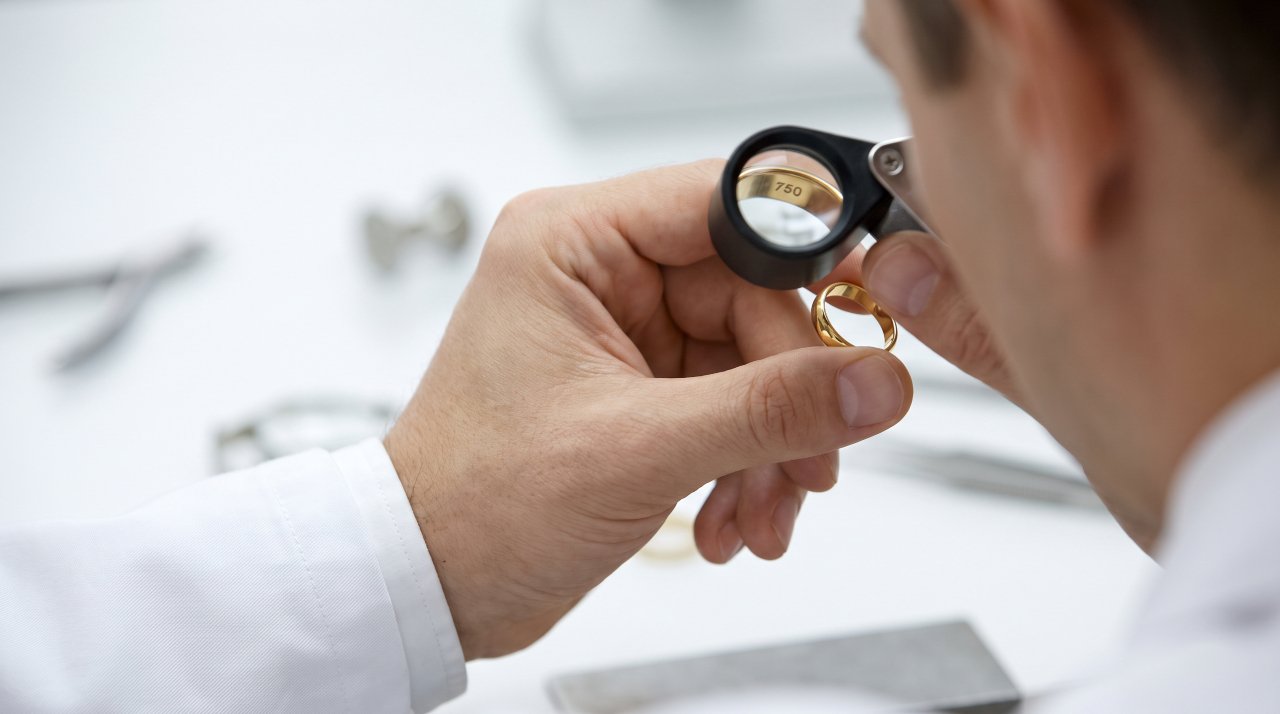
The first thing you should always do is look for a hallmark or stamp. Real gold jewelry almost always carries one. A jeweler’s loupe or even a phone camera on macro mode can help you spot tiny engravings inside a ring band, on a clasp, or near the post of an earring.
Here’s what the most common stamps actually mean:
| Stamp | Karat | Gold Purity |
|---|---|---|
| 999 or 24K | 24 karat | 99.9% pure gold |
| 750 or 18K | 18 karat | 75% pure gold |
| 585 or 14K | 14 karat | 58.5% pure gold |
| 417 or 10K | 10 karat | 41.7% pure gold |
| GF | Gold-filled | Thick layer of gold bonded to base metal |
| GP or GEP | Gold-plated | Thin gold coating over base metal |
| HGE | Heavy gold electroplated | Slightly thicker plating, still not solid gold |
The three-digit numbers (like 585 or 750) are the European standard — they represent parts per thousand. A 585 stamp means 585 out of 1,000 parts are pure gold. In the US, you’ll see both karat markings and numeric stamps on authentic pieces.
The limitation: A stamp alone doesn’t guarantee authenticity. Counterfeiters can and do fake stamps. So treat the stamp as your starting point, not your final answer.
Step 2: The 7 At-Home Tests
Here’s what separates this guide from most others — not every gold test is equally trustworthy. Here’s an honest ranking from most to least reliable.
Test 1: The Magnet Test — Reliability: High (for ruling out fakes)
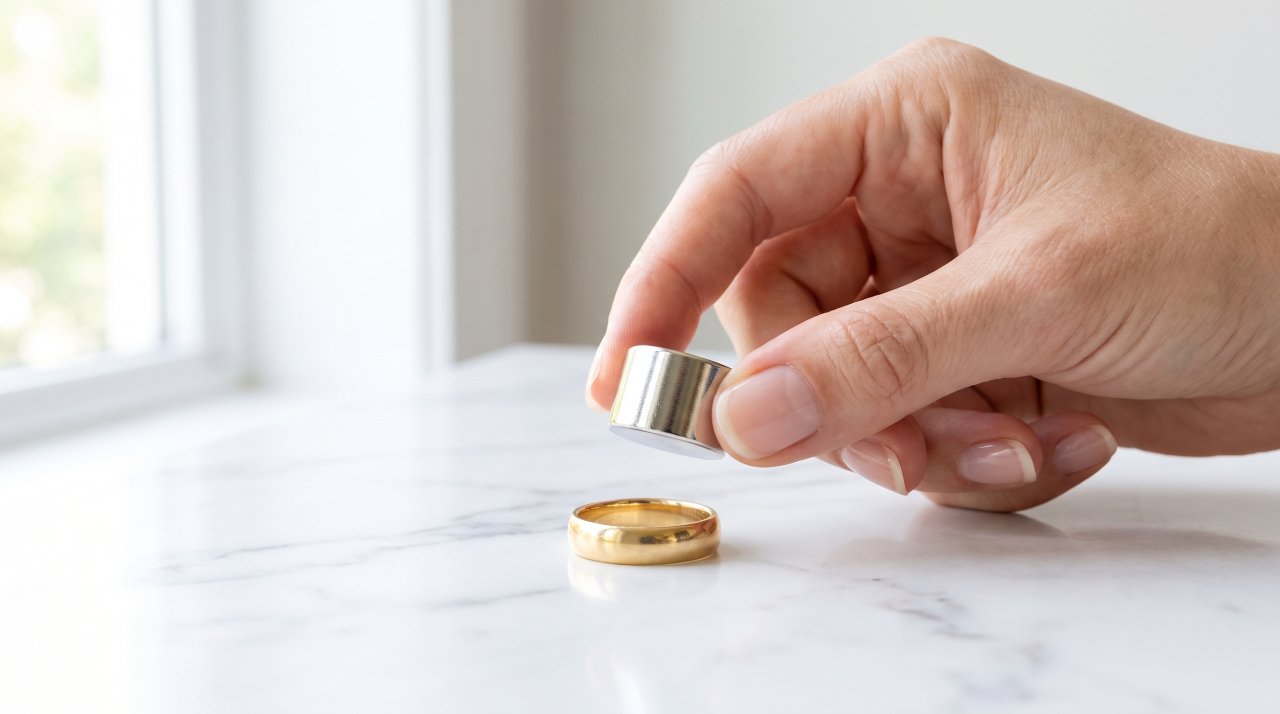
Real gold is not magnetic. Hold a strong rare-earth magnet (neodymium) near your jewelry. If the piece pulls toward the magnet at all, it contains ferrous metals and is not solid gold.
The catch? Some base metals used in fake gold — like copper, brass, or aluminum — are also non-magnetic. So passing the magnet test doesn’t confirm gold. Failing it absolutely rules it out.
Use the magnet test as your first filter, not your final verdict.
Test 2: The Skin Discoloration Test — Reliability: Moderate
Real gold doesn’t react with your skin. Fake gold or gold-plated jewelry often leaves a green, black, or gray mark on your skin due to the base metals underneath reacting with your sweat and skin oils.
Rub the jewelry against clean, dry skin on your inner arm or palm for 30 seconds. A dark or green smear usually means copper or brass underneath. No mark? That’s a good sign — but not definitive proof.
Keep in mind: some people with highly acidic skin can get slight reactions even from lower-karat real gold.
Test 3: The Ceramic Scratch Test — Reliability: Moderate-High
Drag the piece lightly across an unglazed ceramic plate or tile. Real gold leaves a gold-colored streak. Most fake metals leave a black streak.
This test works because real gold is soft and deposits a pure gold color. Be gentle — you don’t want to damage the piece unnecessarily. This method works well for rings and bracelets but can be tricky with delicate chains.
Test 4: The Float Test — Reliability: Low-Moderate
Drop your jewelry into a glass of water. Real gold is very dense — it sinks quickly to the bottom. Fake or hollow gold-plated pieces may float or sink slowly.
This test sounds simple, but it’s not very precise. Many base metals are also dense and sink just as fast. Use this as a supporting clue, not a standalone test.
Test 5: The Nitric Acid Test — Reliability: Very High
This is one of the most accurate at-home tests, but it requires a gold testing acid kit — widely available online for around $15–$30. You make a small scratch on an inconspicuous spot and apply a drop of nitric acid.
Real gold shows no reaction. Base metals bubble, fizz, or turn green. Gold-plated pieces react at the base metal underneath the scratch.
The downside: acid testing does create a tiny scratch on your piece, and the chemicals require careful handling. Wear gloves and work in a ventilated area.
Test 6: The Vinegar Test — Reliability: Low
You’ll see this one recommended everywhere. Drop your jewelry in white vinegar for 15 minutes and watch for a reaction. Real gold supposedly won’t change color.
Honestly? This test is not reliable for confirming gold. Vinegar is a mild acid — it can cause some base metals to discolor, but many plated pieces won’t react visibly either. The nitric acid test is far more accurate. Use vinegar as a rough first pass only if you have nothing else available.
Test 7: Electronic Gold Testers — Reliability: High
Electronic testers measure the electrical conductivity of metal, which varies significantly between gold and common base metals. A quality device gives you a karat reading in seconds.
These testers cost $50–$200, so they’re not for everyone. But if you buy or sell jewelry regularly, electronic gold testers are worth the investment. Professional jewelers use them daily.
Tests That Don’t Work (Myth-Busting)
This section might surprise you — because these “tests” appear in dozens of popular articles.
The Bite Test: Completely Unreliable. You’ve seen it in movies — someone biting a gold coin to check if it’s real. Gold is indeed softer than most metals, so biting it should leave a mark. The problem? Lead is also soft and leaves similar marks. You could easily damage your teeth and still get a false result. Don’t do this.
The Smell Test: Not Valid. Real gold has no odor. But the absence of smell doesn’t confirm gold — plenty of non-gold metals also have no obvious scent.
The Color Test: Unreliable Alone. Gold-plated items look identical to solid gold. Color tells you almost nothing on its own.
Gold-Filled vs. Gold-Plated vs. Solid Gold
Many people confuse these three — and the difference matters a lot for value.
Solid gold (10K–24K) contains gold throughout the entire piece. It’s the most valuable and most durable option. A 14K gold ring will outlast a plated piece by decades.
Gold-filled pieces have a thick layer of real gold mechanically bonded to a base metal core. US law requires gold-filled jewelry to contain at least 1/20th gold by weight. These pieces last years and look similar to solid gold but are worth significantly less.
Gold-plated jewelry has an extremely thin layer of gold applied via electroplating. It can tarnish, wear off, and may cause skin reactions. Many pieces sold as “gold” online are actually plated.
When to Skip the DIY Tests and Go Professional
At-home tests are useful, but they have real limits. You should take your jewelry to a certified jeweler or appraiser if:
- The piece has high sentimental or monetary value
- You’re considering selling, insuring, or inheriting the piece
- At-home tests give you conflicting results
- The piece has no visible hallmark
A professional jeweler can perform an X-ray fluorescence (XRF) test — a non-destructive method that gives you an exact metal composition in minutes. Expect to pay $25–$75 for a professional appraisal, depending on your location. The Gemological Institute of America (GIA) offers certified appraisal services and can point you to qualified appraisers in your area.
That small cost is absolutely worth it for any piece valued over a few hundred dollars.
FAQ
How can you tell if jewelry is real gold without markings?
No hallmark doesn’t automatically mean fake — older pieces, handmade jewelry, and some imported items often lack stamps. Combine the magnet test, the ceramic scratch test, and a nitric acid test for the most reliable result without a stamp. If the piece has significant value, take it to a jeweler for an XRF test.
Does real gold stick to a magnet?
No. Real gold is not magnetic. If your jewelry sticks to or is attracted by a magnet, it contains ferrous metal and is not solid gold. However, passing the magnet test doesn’t confirm gold — non-magnetic base metals like copper and brass also won’t stick.
Will real gold turn your skin green?
Real solid gold won’t turn your skin green. Green or black discoloration happens when base metals like copper react with skin moisture and oils. Lower-karat gold (10K) contains more base metals, so some people with acidic skin may notice slight discoloration even from real lower-karat pieces — but it’s far less common than with fake gold.
Does real gold turn black?
Solid high-karat gold doesn’t tarnish or turn black. Lower-karat gold (10K or 14K) can occasionally show some surface tarnish because of the alloy metals mixed in, but it’s usually minor and polishes off easily. If a piece turns significantly black, it’s likely gold-plated or not gold at all.
How do you test gold with vinegar?
You can soak a piece in white vinegar for 15 minutes and watch for color changes. Fake metals often discolor or dull in acid. Real gold stays unchanged. That said, this test is only a rough guide — the nitric acid test is far more accurate and reliable for confirming gold.
What does real gold look like?
Real gold has a warm, rich yellow color that doesn’t fade or look brassy. High-karat gold (18K–24K) looks noticeably deeper and richer in color. Lower-karat gold looks slightly paler or slightly more yellow. If a piece looks bright orange-yellow or has a surface that looks “painted” or uneven, that’s worth investigating further.
Your Next Step
The single most important thing to take away from all of this: start with the stamp, then use the magnet test, and if you’re still not sure, reach for the nitric acid test or visit a professional jeweler. That three-step approach catches the vast majority of fakes and gives you real confidence in what you’re holding.
Don’t rely on one test alone. Don’t bite your jewelry. And don’t let a missing hallmark panic you — it just means you need to dig a little deeper.
If you’re about to make a significant purchase, take five minutes to verify before you spend. Gold is worth the effort.

