
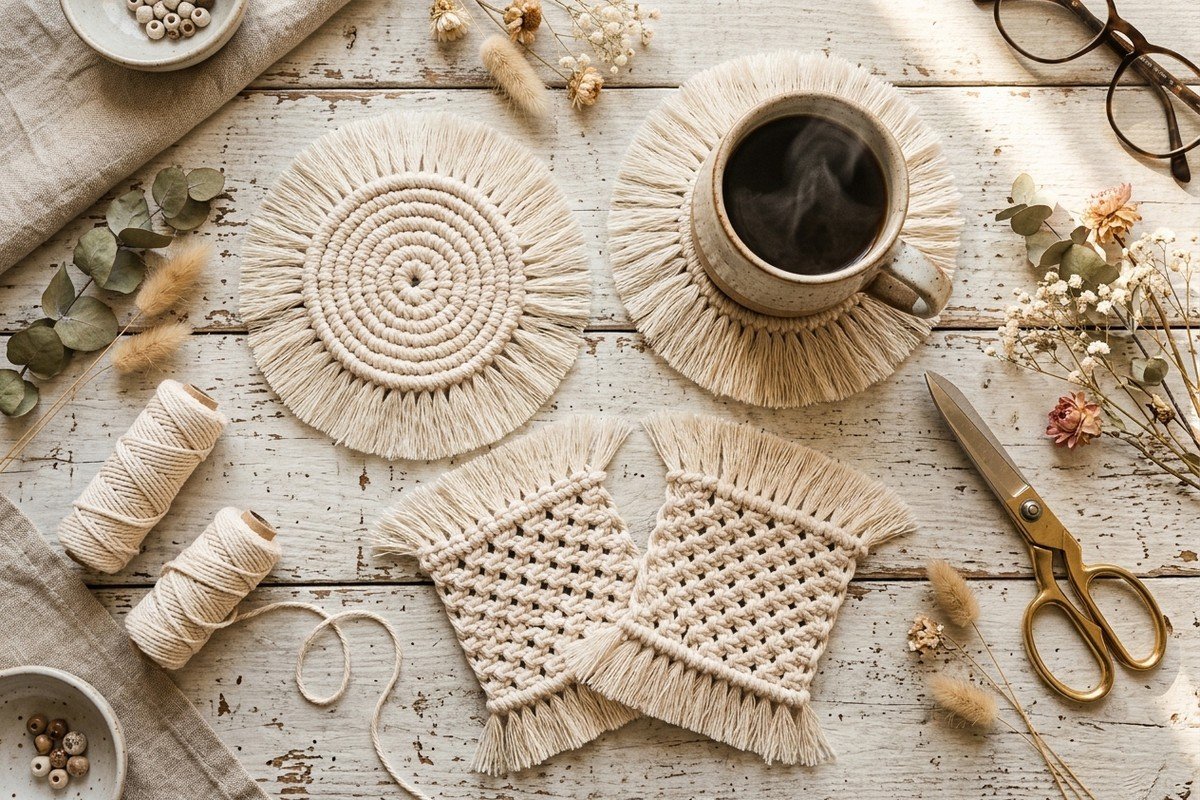
Quick Project Summary
DIY macrame coasters are functional bohemian tabletop mug rugs crafted from 3mm or 4mm single-twist unbleached natural cotton cord. Available in two primary aesthetic styles—round circular spirals knotted with continuous double half-hitches or modern square mats knotted with alternating square knots—each 5-inch coaster takes 20 to 35 minutes to make and costs less than $1.20 in materials. Finished with a combed 1.25-inch fluffy fringe halo, they protect delicate wood tabletops from coffee mug condensation and heat.
Unlike complex large-scale tapestries, coasters require only a small investment in 3mm cotton cord and can be completed in a single afternoon. In this comprehensive step-by-step master guide, you will learn the exact cord formulas, circular expansion techniques, square knot lattices, and fringe-trimming secrets to craft durable, perfectly flat macrame coasters.
Materials, Cord Sizing & Dimensions Matrix
Using high-quality single-twist or 3-ply twisted cotton cord is critical for achieving a plush, cloud-like fringe border that brushes out easily without tangling. Review the master material specifications below:
| Supply / Tool | Recommended Specification | Quantity (Per Coaster) | Artisan Purpose |
|---|---|---|---|
| Cotton Macramé Cord | 3mm single-twist or 3-ply unbleached natural cotton | 35 to 45 feet (11–14 meters) | Forms the core knot work and soft outer fringe border |
| Cork Knotting Board / Pins | 12×12 inch cork tile + stainless T-pins | 1 board + 10 pins | Anchors the central anchor cord to maintain symmetrical tension |
| Metal Pet Slicker Brush | Fine wire bristle slicker comb | 1 brush | Unravels dense cotton rope plies into a smooth, fluffy halo |
| Fabric Shears | 8-inch razor-sharp tailor scissors | 1 pair | Ensures clean, crisp circular and straight fringe perimeter cuts |
For sustainable textile sourcing and chemical-free fiber certifications, consult guidelines from the OEKO-TEX Sustainable Textile Standard. For more knotting inspiration, explore our beginner guides on how to make a beginner macrame wall hanging and large driftwood macrame tapestries.
Pattern 1: Round Spiral Macramé Coaster Tutorial
Step 1: Knotting the Center Ring & Continuous Spiral Hitch
The round circular coaster is constructed using continuous diagonal double half-hitches (clove hitches) wrapped around an expanding spiral lead cord.
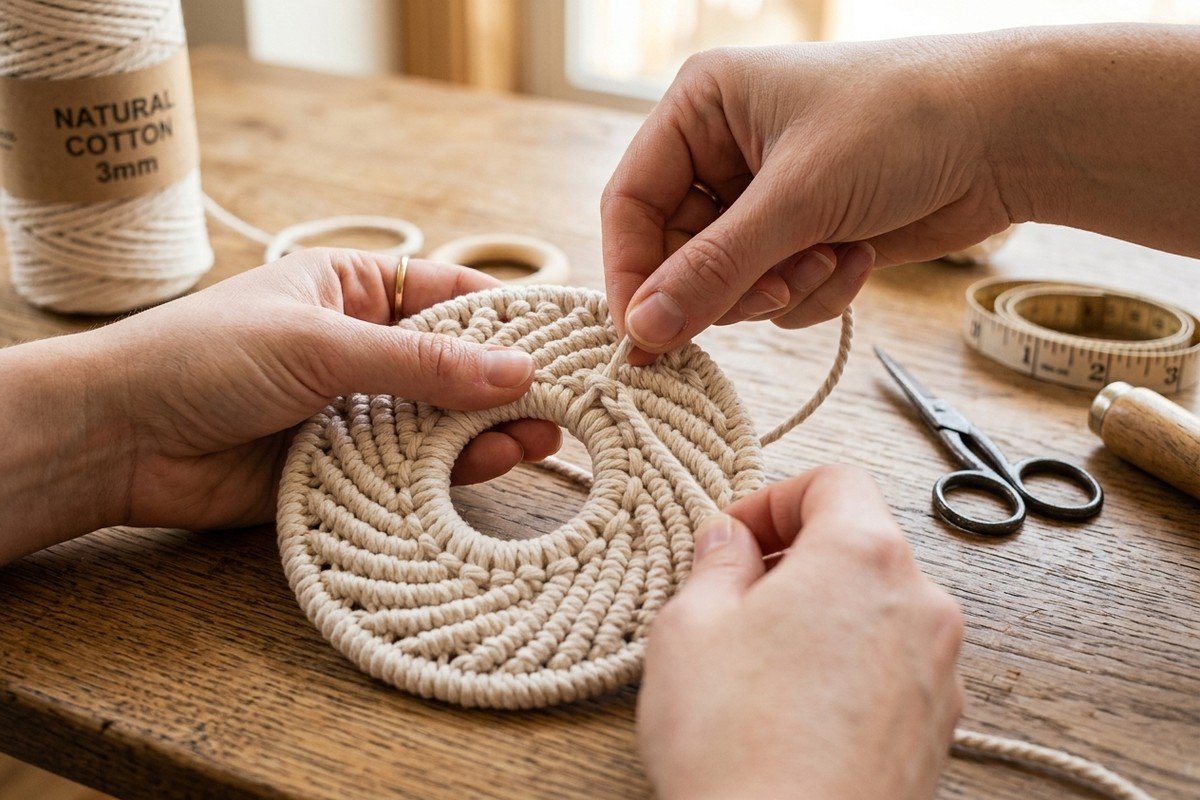
- Cut Cords: Cut 1 Leading Filler Cord measuring 8 feet (2.5 meters), and 5 Working Strands measuring 32 inches (80 cm) each.
- Form Center Ring: Fold your 5 working strands in half and attach them to the center of your lead cord using tight Lark’s Head knots, forming a compact semi-circle.
- Begin the Spiral: Curve the long lead cord clockwise in a spiral path around the center cluster. Using each hanging working strand in sequence, tie two tight Half-Hitches over the lead cord.
- Add Expansion Strands: As the circle expands outwards in Row 2 and Row 3, the spacing between working cords widens. To keep the coaster completely flat, insert 4 to 6 additional 16-inch folded cords onto the lead cord with Lark’s Head knots whenever a gap exceeds 0.25 inches.
- Complete 5 Concentric Rings: Continue spiraling until the solid knotted center measures 3.5 inches in diameter.
Pattern 2: Modern Square Boho Coaster Tutorial
Step 2: Alternating Square Knot Diamond Grid
Square macramé coasters offer a crisp geometric aesthetic, featuring tight square knot meshes and dramatic fringe on opposing ends.
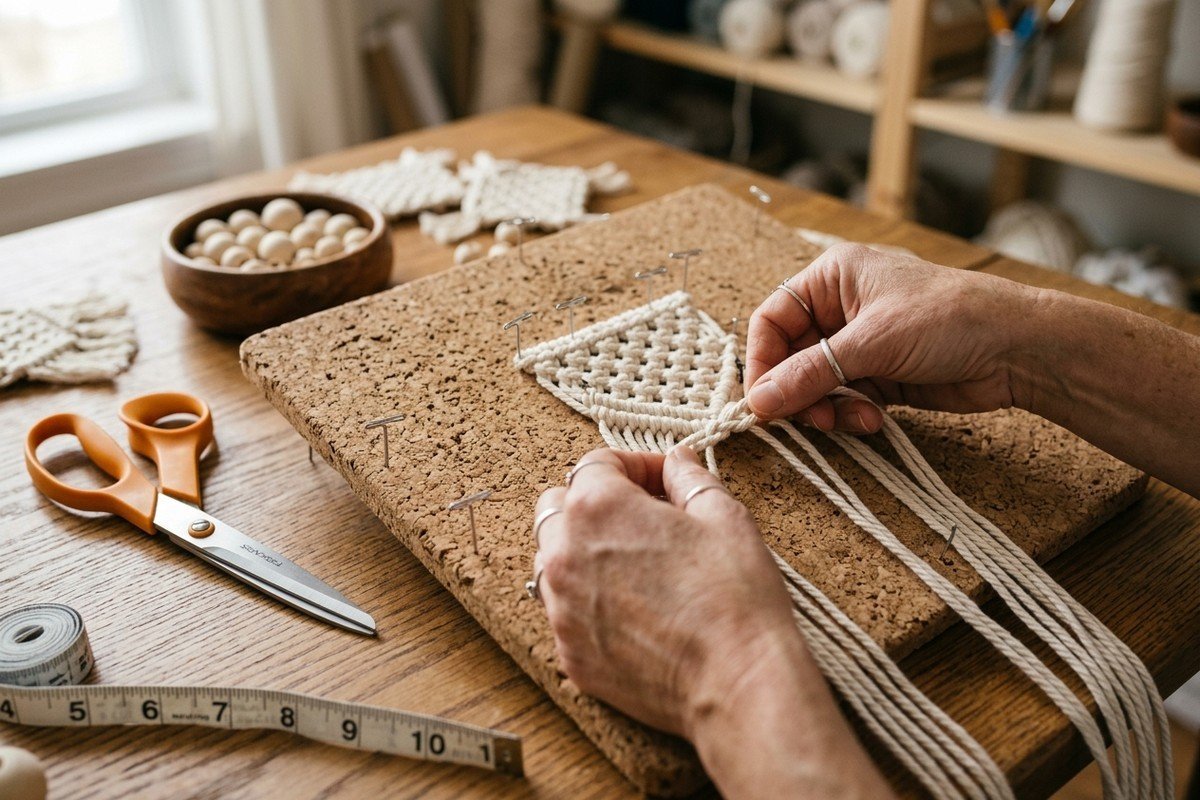
- Cut Working Strands: Cut 8 working strands measuring 36 inches (90 cm) each, and 1 horizontal anchor cord measuring 12 inches.
- Mount to Anchor Cord: Pin the 12-inch anchor cord horizontally across your cork board. Mount all 8 strands using Lark’s Head knots to create 16 vertical working cords.
- Row 1: Group cords into 4 sets of 4 and tie 4 Square Knots directly below the mounting line.
- Row 2 (Alternating): Leave the first 2 cords unworked. Tie 3 Alternating Square Knots using 2 cords from adjacent knots, leaving the last 2 cords unworked.
- Repeat for 7 Rows: Continue alternating rows until the knotted square body measures 3.75 × 3.75 inches.
- Lock the Bottom: Tie a final row of horizontal double half-hitches across all cords using a separate 12-inch cord to lock the weave securely.
Phase 3: Combing, Trimming & Stiffening the Fringe Halo
The outer fringe halo gives macramé coasters their iconic plush texture. Perfect circular trimming requires precision tools and technique:
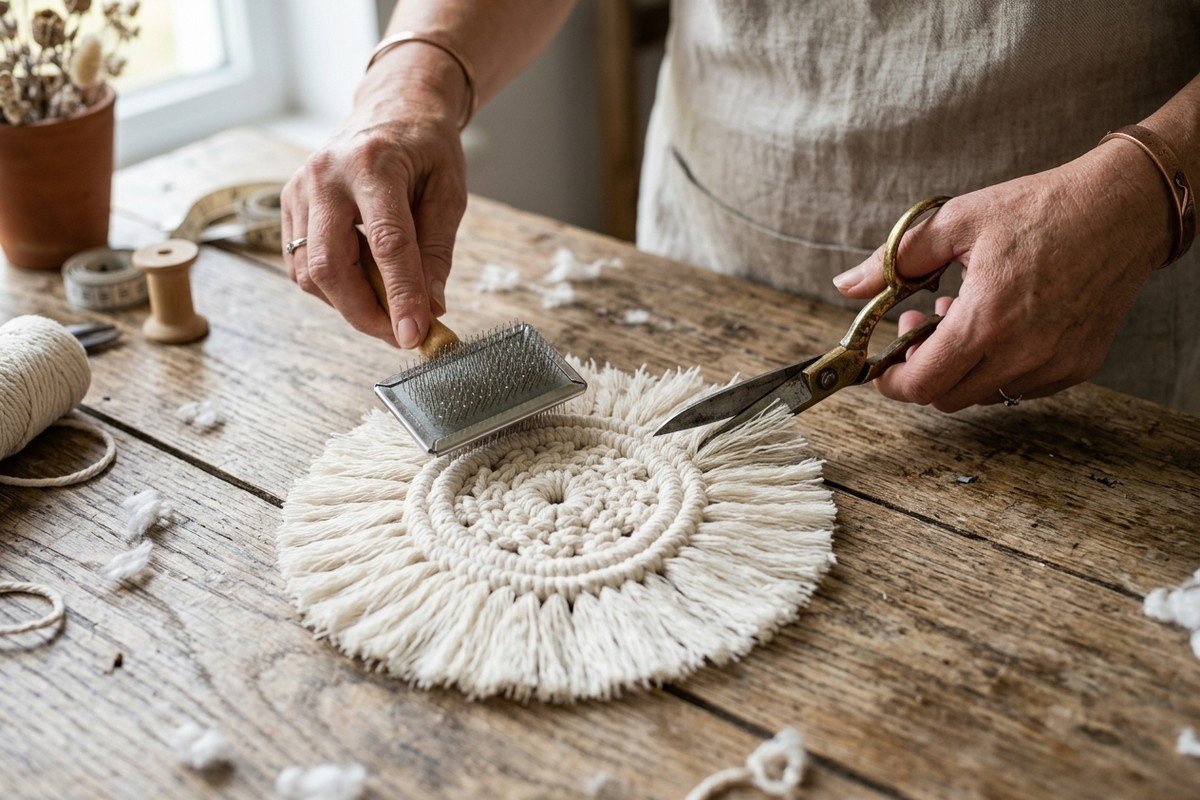
- Step 1: Comb the Cord Plies: Lay the coaster flat on your worktable. Using a fine wire pet slicker brush or metal comb, brush the fringe strands from the knot base outward, separating the twisted fibers into soft cotton fleece.
- Step 2: Use a Circular Cutting Guide: Place a 5-inch round glass jar lid or small ceramic saucer centered directly over the knotted coaster body.
- Step 3: Precision Trim: Trace around the edge of the lid with sharp tailor shears, cutting the fringe to an exact uniform 1.0 to 1.25-inch length.
- Step 4: Optional Fiber Stiffening: To keep fringe permanently flat and resistant to curling, lightly mist the back of the fringe with fabric stiffener spray or extra-hold hairspray. For more tips on keeping cotton fibers stiff, review our popular tutorial on how to make macramé leaves that stay flat.
Troubleshooting & Tabletop Care
| Common Issue | Root Cause | Workshop Solution |
|---|---|---|
| Coaster Bowls Up (Curling into a Bowl) | Too few working cords; spiral circumference is too tight | Add 2 to 3 more expansion strands with Lark’s Head knots to increase outer perimeter width. |
| Coaster Ruffles / Waves (Rippling Edges) | Too many expansion cords inserted; outer perimeter has excess fiber | Space expansion strands farther apart (every 3 to 4 knots instead of every 2 knots). |
| Coffee Stains on Unbleached Cotton | Liquid beverage spills absorbed by natural raw cotton | Spot clean with warm water and mild dish soap; press flat under a heavy book while air-drying. |
Natural Dyeing Techniques for Boho Cotton Coasters
While unbleached natural cotton offers a timeless minimalist look, infusing your macramé coasters with botanical earth tones elevates them into boutique-quality gift sets. Try these non-toxic kitchen dye methods:
1. Dusty Rose Avocado Seed Dye Bath
Simmer 3 clean avocado pits and skins in 4 cups of water for 45 minutes to release rich natural tannins. Strain the liquid, submerge your finished cotton coasters for 20 to 60 minutes, and rinse in cold water for an earthy millennial blush pink tone.
2. Warm Terracotta Black Tea & Coffee Stain
Brew 4 bags of strong black tea or 1 cup of dark roast coffee in hot water. Dip only the outer 1 inch of unraveled cotton fringe into the brew for 5 minutes to produce a vintage sun-drenched dip-dyed ombre halo.
Pattern 3: Geometric Hexagon Macramé Coaster
For advanced knotters, a six-sided hexagonal coaster offers modern geometric flair on marble or glass coffee tables:
- Cut Working Strands: Cut 6 main anchor cords measuring 24 inches each and 12 filler cords measuring 18 inches each.
- Center Star Anchor: Knot the 6 main cords into a central 6-point star using Lark’s head loops around a 1-inch brass ring or cord loop.
- Diagonal Half-Hitch Petals: Working outward from each point of the star, tie outward-angled diagonal clove hitches to create 6 distinct triangular facets.
- Interlock Facets: Connect adjacent triangular points with alternating square knots to form crisp straight outer perimeter edges.
- Trim Corner Tassels: Leave 1.5 inches of fringe at each of the 6 outer corner vertices, comb out with a slicker brush, and trim to sharp points.
Boho Tablescape Styling & Gift Packaging Ideas
Handmade macramé coasters are versatile styling elements that add texture and artisanal elegance across every room in your home:
- The Coffee Station Vignette: Rest your favorite ceramic coffee mug on a round spiral coaster paired with a mini glass creamer pitcher and a small ceramic sugar bowl on a rustic wooden tray.
- Bedside Carafe & Plant Base: Place a square macramé coaster beneath a small glass water carafe or mini potted succulent on floating wooden nightstands to protect sealed timber finishes from scratches and water rings. Coordinate with our boho chic bedroom styling ideas.
- Wedding & Housewarming Gift Sets: Stack 4 matching round or square coasters, wrap with natural jute twine or blush chiffon ribbon, tuck a sprig of dried eucalyptus or lavender beneath the knot, and attach a kraft paper gift tag for boutique handmade gifting.
- Outdoor Patio Dining Tablescape: Layer round cotton fringe coasters beneath outdoor citronella candles and wine glasses on teak patio tables for relaxed summer entertaining.
Step-by-Step Cord Length Calculation for Custom Sized Mug Rugs
If you want to scale up your coasters into oversized 8-inch teapot trivets or 12-inch circular plant mats, use our universal workshop formula:
Circular Coaster Math Formula:
Leading Cord Cut Length = Desired Finished Diameter (inches) × 24 inches
Example: For a large 8-inch teapot trivet, your leading continuous filler cord should be 8 × 24 = 192 inches (16 feet), and you will need 12 to 14 additional expansion strands measuring 20 inches each inserted along the spiral.
Frequently Asked Questions (FAQ)
Q: What is the best cord thickness for macramé coasters?
A: 3mm or 4mm single-twist cotton cord is ideal. Single-twist cord brushes out into ultra-soft fringe in seconds, while 3mm thickness keeps the coaster flat and stable so drinking glasses do not wobble or tip over.
Q: Can you wash handmade macramé coasters in the washing machine?
A: No. Machine washing will cause the unraveled fringe to mat and tangle permanently. Always hand-wash gently by submerging in lukewarm soapy water, rinsing, pressing between dry towels, and combing the fringe flat while damp.
Q: How long does it take a complete beginner to make one macramé coaster?
A: A square coaster takes approximately 20 to 25 minutes, while a round spiral coaster takes 30 to 40 minutes for beginners. Once you master the rhythm of the knots, a set of 4 can easily be completed in under two hours.

