

Most beginners waste their first $20 on the wrong cord — and it quietly ruins their first project before they’ve tied a single knot. Picking the right macramé cord isn’t just about grabbing whatever looks pretty at the craft store. The material you choose affects how your knots look, how easy your hands find the work, and whether your finished piece holds up or falls apart after a month. If you’re just starting out, this decision matters more than most tutorials admit.
By the end of this guide, you’ll know exactly what separates cotton, jute, and nylon cords, which one suits your first project, and what no one else tells you about how each material actually behaves in your hands. Let’s get into it.
What Is Macramé Cord, Exactly?
Macramé cord is the fiber you use to tie knots and create patterns. But not all cord is created equal — and the construction of the cord matters just as much as the material.
You’ll find three main construction types on the market:
Single strand (also called string): One continuous length of fiber, slightly fuzzy when unraveled. Great for fringe and wall hangings where you want that soft, bohemian look.
3-ply twisted: Three strands twisted together. This is the most common type you’ll see recommended for beginners. It’s easy to unravel for fringe effects and holds knots cleanly.
Braided cord: Multiple strands woven together in a braid. Braided cord is stronger, smoother, and less forgiving to unravel — but it creates very neat, defined knots.
Most beginner tutorials assume you already know this. They don’t explain it. Now you do.
Why Your Cord Choice Affects Your Knots
Here’s something competitors almost never mention: the material of your cord changes how your knots behave under tension.
Cotton grips itself well, which means your square knots stay tight without slipping. Jute has a rougher texture that creates firm knots — almost too firm to undo if you make a mistake. Nylon is slippery, which makes tying certain knots trickier until you’ve built some muscle memory.
According to the Craft Yarn Council’s fiber standards, natural plant-based fibers like cotton and jute absorb tension differently than synthetic fibers, which directly impacts drape and final shape of textile work. This is why most experienced macramé artists recommend natural fibers to beginners — not because synthetics are bad, but because natural fibers are more forgiving while you’re still learning.
Your first project deserves a cord that works with you, not against you.
Cotton Macramé Cord: The Beginner’s Best Friend

Cotton cord is the most popular choice for beginners, and that reputation is well-earned.
Why cotton works so well:
Cotton is soft, flexible, and easy on your hands during long knotting sessions. It holds knots firmly without being so stiff that you struggle to move the fibers. When you make a mistake — and you will, because everyone does — cotton is forgiving enough to untie and redo without shredding the fiber.
Cotton also comes in the widest range of sizes. You’ll typically see it sold in 3mm, 5mm, and sometimes up to 10mm thickness. For your first project, macramé educators commonly recommend starting with 3mm–5mm single-strand or 3-ply cotton cord, as this thickness makes knots visible enough to follow while learning.
The honest downside: Cotton cord can shrink slightly if it gets wet and isn’t dried properly. It also attracts dust if you’re making wall hangings in a dusty environment. That’s not a dealbreaker — it just means you’ll want to give finished pieces an occasional gentle shake or light steam.
Best beginner projects for cotton cord:
- Wall hangings
- Plant hangers
- Keychains and small decorative pieces
- Macramé bags (with 3mm braided cotton)
Cotton is also the most budget-friendly option overall. You can find good quality 3-ply cotton macramé cord for around $10–$18 per 100m spool, depending on the brand and where you shop.
Jute Macramé Cord: The Natural Choice With Trade-Offs
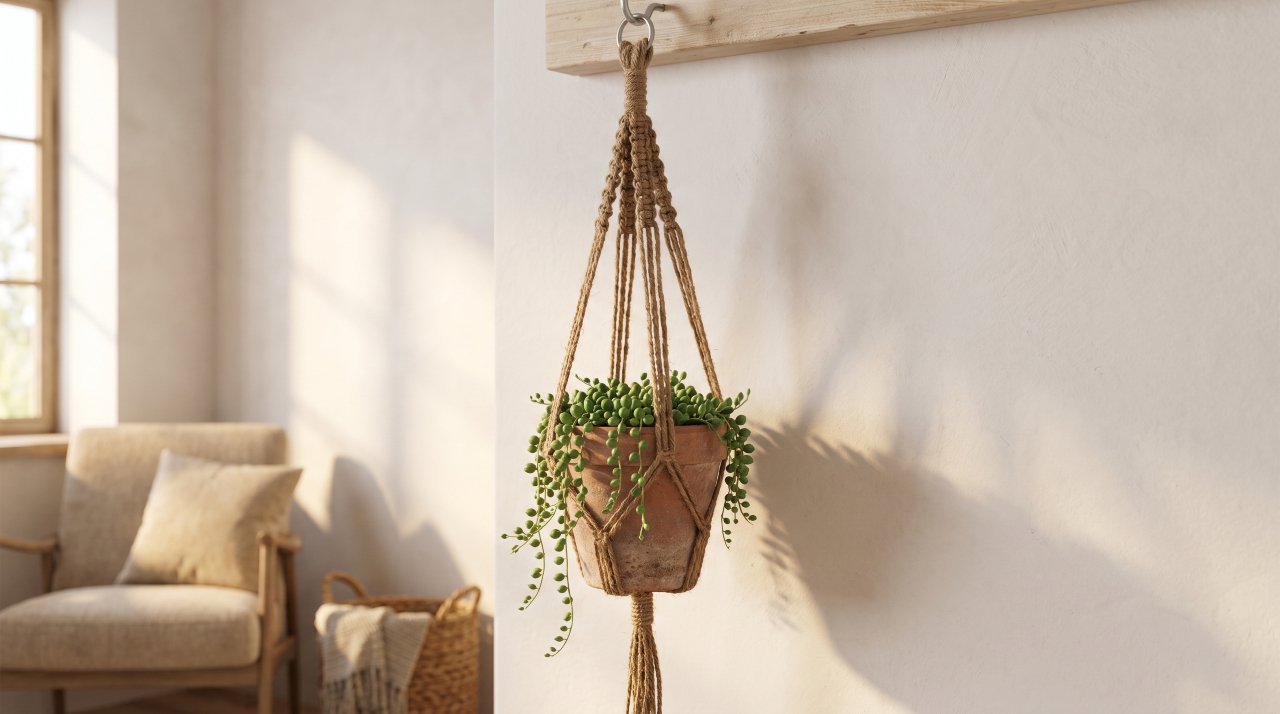
Jute cord gives that earthy, rustic look that’s almost synonymous with 1970s-style macramé. It’s made from natural plant fibers, fully biodegradable, and has that unmistakable rough, organic texture.
Where jute shines: Jute is excellent for plant hangers where you want a natural, garden-ready aesthetic. It’s also stiffer than cotton, which means it holds structured shapes well. If you’re making a pot holder or a hanging basket, jute gives you that sturdy, load-bearing quality.
The honest downside: Jute is rougher than cotton, and that roughness is hard on your hands during long sessions. If you’re planning a big wall hanging that takes several hours, jute can leave your palms sore and red. It’s also not moisture-resistant — jute weakens when wet, which makes it a poor choice for outdoor projects or bathroom plant hangers exposed to regular humidity.
Jute also frays more aggressively than cotton when you cut it, so you’ll want sharp scissors and a lighter or clear nail polish to seal the ends.
Best beginner projects for jute cord:
- Indoor plant hangers
- Decorative rope baskets
- Rustic wall decor
- Gift wrapping and packaging
Jute cord is typically cheaper than cotton — around $6–$12 per 100m — making it a low-risk option to experiment with.
One more thing worth knowing: jute cord sold in hardware stores is not the same as macramé jute. Hardware jute is often treated with oils or chemicals that make it stiff and unpleasant to work with. Always buy jute marketed specifically for craft or macramé use.
Nylon Macramé Cord: Strong, Shiny, and Situational
Nylon cord is the outlier in this trio. It’s synthetic, strong, and has a smooth, slightly shiny surface that gives finished pieces a very different look from natural fibers.
Where nylon works: Nylon is the go-to for outdoor macramé and functional pieces like hammocks, pet hammocks, or outdoor plant hangers. It’s water-resistant, UV-resistant (to a degree), and won’t rot or mold if exposed to humidity. According to materials testing published by the American Chemical Society, nylon retains over 85% of its tensile strength even after prolonged exposure to moisture — which natural fibers can’t match.
The honest downside for beginners: Nylon is slippery. That slipperiness makes square knots and half-hitch knots harder to keep tight while you work. You’ll find yourself re-tightening knots more often, which is frustrating when you’re still learning the motions. Nylon also doesn’t unravel into that soft fringe look that cotton gives you, so decorative fringe effects are mostly off the table.
It’s also more expensive than both cotton and jute, typically $15–$25 per spool depending on thickness.
Best beginner projects for nylon cord:
- Outdoor plant hangers
- Pet hammocks
- Functional knotted straps or handles
- Keychains (nylon holds up to daily wear)
Honestly? Unless you specifically need weatherproof durability, skip nylon for your very first project. Get comfortable with cotton first, then branch out.
Head-to-Head Comparison: Cotton vs Jute vs Nylon
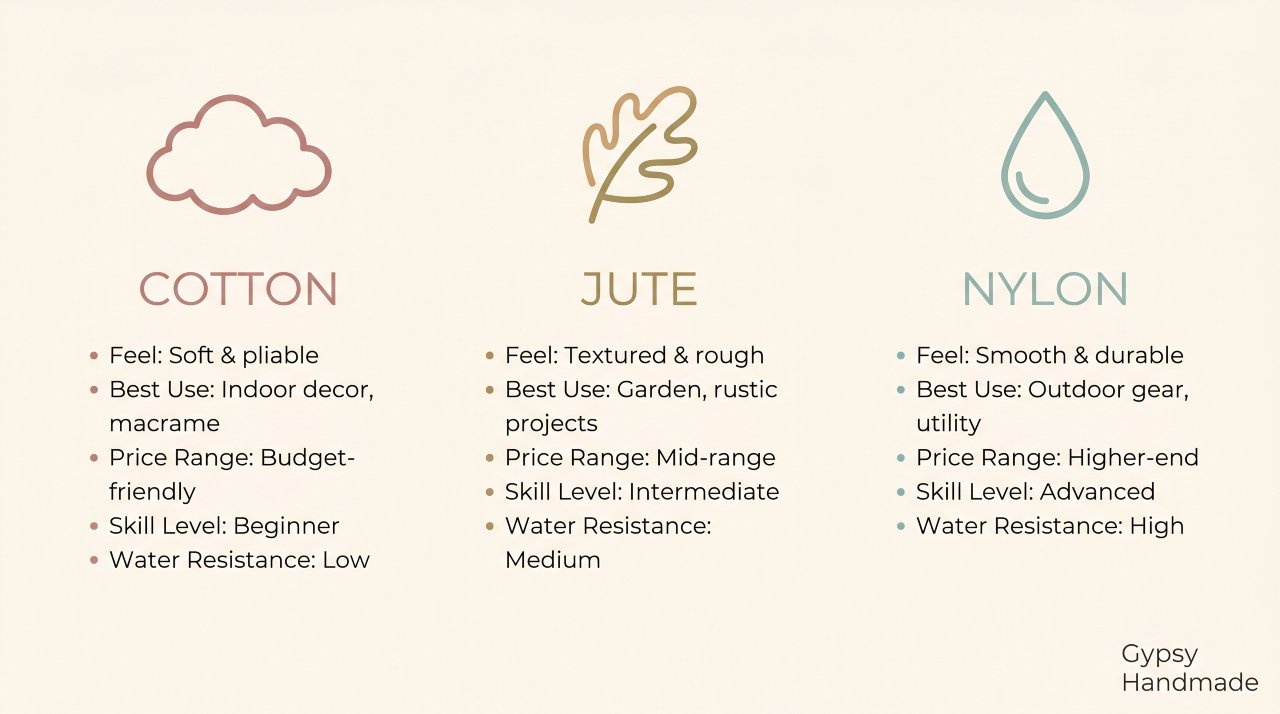
| Feature | Cotton | Jute | Nylon |
|---|---|---|---|
| Feel in hands | Soft, gentle | Rough, textured | Smooth, slippery |
| Ease for beginners | ⭐⭐⭐⭐⭐ | ⭐⭐⭐ | ⭐⭐ |
| Knot grip | Excellent | Very firm | Slips easily |
| Water resistance | Low | Very low | High |
| Outdoor use | No | No | Yes |
| Fringe effect | Beautiful | Rough/coarse | Not suitable |
| Price per 100m | $10–$18 | $6–$12 | $15–$25 |
| Eco-friendly | Yes | Yes | No |
| Best first project | Wall hanging | Plant hanger | Outdoor hanger |
Cord Thickness: What Size Should You Start With?
This is the question almost every beginner has — and almost no article answers clearly.
3mm cord is the sweet spot for most beginner projects. It’s thick enough that you can see your knots clearly, thin enough to be manageable, and widely available in cotton and jute. Start here.
5mm cord works well for chunkier wall hangings or when you want a more statement piece with bolder knots. It’s easier to handle but uses up yardage faster, so projects cost more in materials.
1mm–2mm cord is better suited for jewelry, small keychains, or fine detail work. It’s not ideal for your very first project because the smaller scale makes mistakes harder to spot and correct.
Pro tip from experienced crafters: Buy a small amount of two different thicknesses before committing to a big spool. Tie a few practice knots and see which one feels right in your hands. Everyone has a personal preference, and you’ll know almost immediately which thickness feels natural.
Common Beginner Mistakes Related to Cord Choice
No one talks about these, but they’re the real reason beginners get frustrated.
Buying too little cord. Macramé uses a lot more cord than you’d expect. A standard rule of thumb is that your working cords should be 4–5 times the finished length of your project. Many beginners buy one small skein and run out halfway through. Always buy more than you think you need.
Confusing “rope” and “cord.” Macramé rope is usually thicker (8mm+) and is better suited for large-scale projects like hammocks or chair swings. Macramé cord covers everything smaller. If a tutorial says “cord,” don’t substitute thick rope — the knot structures won’t work the same way.
Using craft store yarn instead of macramé cord. Regular knitting or crochet yarn is too stretchy and too thin for macramé. It won’t hold knots properly and the finished piece will look limp. Always use cord or rope specifically made for macramé or at least labeled as “zero-twist” or “single strand.”
How Environment Affects Your Cord Choice
This is something competitors almost universally skip — and it genuinely matters.
If you live in a humid climate (like Florida, Houston, or the Pacific Northwest coast), jute is a risky choice for any decor piece that lives indoors near windows or bathrooms. Humidity weakens jute fibers over time and can cause mildew if the piece doesn’t dry fully after absorbing moisture from the air.
Cotton handles average indoor humidity fine. In very dry climates (like Arizona or Colorado), cotton cord can stiffen slightly — a light mist of water and air drying will soften it back up.
Nylon is genuinely the best performer in high-humidity or outdoor settings. If your plant hanger lives on a covered porch in a rainy area, nylon is worth the extra cost and the learning curve.
The Textile Research Journal notes that natural plant-based fibers lose up to 30% of their tensile strength at very high humidity levels over time — important context if you’re making load-bearing pieces like plant hangers that hold heavy pots.
FAQ: Your Top Cord Questions Answered
What is the best macramé cord for absolute beginners?
Cotton cord, specifically 3mm 3-ply twisted cotton, is the best starting point. It’s soft, widely available, easy on your hands, and holds knots without slipping. You can also unravel it easily if you make a mistake, which you will at first — and that’s completely normal.
Is jute or cotton better for macramé?
Cotton is better for most beginner projects because it’s softer and more forgiving. Jute works well for plant hangers and rustic decor where you want a natural, earthy look — but it’s rougher to work with and not suitable for humid or wet environments.
What thickness of macramé cord should a beginner use?
Start with 3mm cord for your first project. It’s the most versatile size, works with most beginner-level patterns, and gives you enough visual clarity to see and correct your knots as you learn.
What is the difference between macramé rope and cord?
Macramé cord typically refers to thinner material (1mm–6mm) used for detailed projects like wall hangings, bags, and plant hangers. Macramé rope is thicker (8mm and above) and is used for large structural pieces like hammocks or swing chairs. Most beginner tutorials use cord, not rope.
Can you use any rope for macramé?
Not really. Macramé requires cord or rope that’s low-stretch and holds knots without slipping. Knitting yarn is too stretchy, hardware rope is often chemically treated, and paracord is too slippery for decorative knotwork. Stick to cord marketed for macramé or fiber arts.
Is nylon good for macramé beginners?
Nylon is better suited to intermediate crafters because its smooth, slippery surface makes knots harder to keep tight while you’re learning. It’s excellent for outdoor and functional projects, but cotton gives you a much easier learning experience when you’re starting out.
The One Takeaway That Changes Everything
If you remember just one thing from this guide, make it this: start with 3mm 3-ply cotton cord for your first project, no matter what.
Cotton gives you the best possible learning experience. It’s forgiving, soft, widely available, and works for almost every beginner pattern you’ll find online. Once you’ve finished two or three projects and your hands know the knots by instinct, then experiment with jute for that rustic aesthetic, or try nylon if you want to make something for outdoor use.
Don’t overthink the cord choice at the start. The best cord for a beginner is the one that gets out of your way and lets you focus on learning the knots.
