
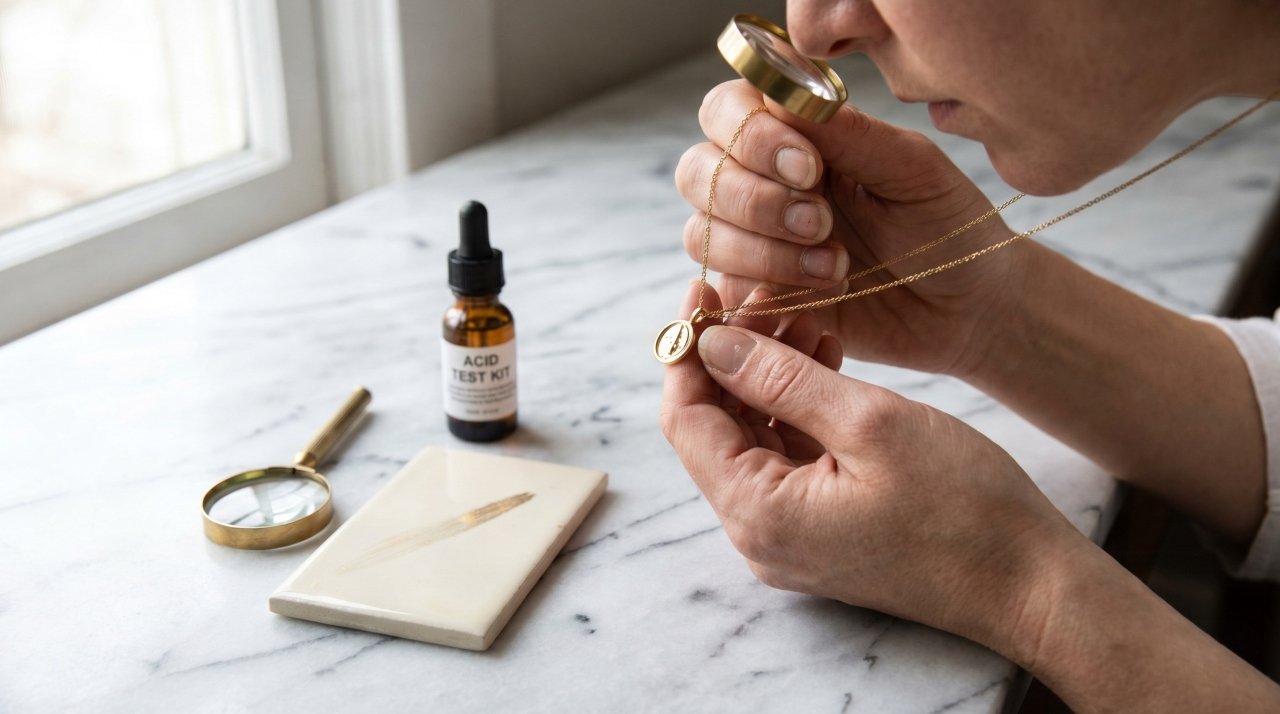
About 10% of gold sold online is counterfeit or misrepresented, according to industry reports from jewelry trade organizations. That number goes up even higher when you factor in thrift stores, estate sales, and private sellers who may not even know what they are actually selling. If you have a necklace sitting in a drawer right now and you are not sure whether it is real gold, that uncertainty is completely normal — and very fixable.
This article walks you through seven reliable ways to tell if your necklace is real gold. Some tests you can do right now with things already in your home. Others take five minutes and cost nothing. By the time you finish reading, you will know exactly what steps to take and whether you need to bring your piece to a professional.
Who This Article Is Actually For
This is for you if you have a necklace and you genuinely do not know if it is real gold. Maybe you got it as a gift and the person who gave it did not know either. Maybe you picked it up at an estate sale, a flea market, or a secondhand shop. Maybe you bought it online and the listing said “gold” but you are second-guessing it now.
This is also useful if you are thinking about selling the necklace and want to know its actual value before you walk into a pawn shop or jewelry store. Knowing what you have puts you in a much stronger position. This article is not for jewelers or experts. It is for regular people who just want a straight answer.
What “Real Gold” Actually Means (And Why It Gets Confusing)
Here is something that trips people up: a necklace can be labeled “gold” and still not be what most people picture when they hear that word.
Solid gold jewelry is made entirely from a gold alloy, meaning gold mixed with other metals to make it stronger. Pure gold is 24 karats, but it is too soft for everyday jewelry, so most pieces are 10k, 14k, or 18k. Those numbers tell you how much of the metal is actually gold. A 14k necklace is 58.3% gold. A 10k necklace is 41.7% gold. Both are considered real gold.
Gold plated jewelry is a completely different story. It is made of a base metal like brass or copper, then dipped in a thin layer of gold. It looks almost identical to solid gold at first glance. Over time, the gold layer wears off and the base metal shows through. Gold filled jewelry sits in between — it has a thicker layer of gold bonded to a base metal, but it is still not solid gold.
This matters because when you are testing your necklace, you are really trying to figure out which category it falls into. The tests below help you do exactly that.
7 Ways to Tell If Your Necklace Is Real Gold
1. Look for Hallmarks or Karat Stamps
Start here. This is the easiest step and it takes about 30 seconds.
Pick up your necklace and look closely at the clasp, the inner surface of any pendant, or anywhere the metal is thick enough to stamp. Real gold jewelry sold in the United States is legally required to have a karat stamp if a karat claim is made. You are looking for numbers like 10K, 14K, 18K, 24K, or their decimal equivalents: 417 (10k), 585 (14k), 750 (18k).
A magnifying glass helps a lot here. Stamps can be tiny. If you see “GP” or “GF” that stands for gold plated or gold filled — not solid gold. No stamp at all is a warning sign, though older or handmade pieces sometimes lack them.
Do not stop here though. Stamps can be faked on counterfeit pieces.
2. Try the Magnet Test
Gold is not magnetic. This test takes about ten seconds.
Hold a strong magnet (a rare earth or neodymium magnet works best — the kind on industrial refrigerator clips) near your necklace. If the necklace pulls toward the magnet or sticks to it, there is a magnetic metal inside. Real gold will not respond to the magnet at all.
The catch: some fake gold uses non-magnetic base metals like copper or brass. So passing this test does not guarantee real gold — but failing it almost certainly means it is not solid gold.
3. Check for Discoloration on Your Skin or the Jewelry
Real gold does not react with skin or air the same way fake metals do.
If you have worn this necklace and noticed green or black marks on your skin, that is a sign of a base metal reacting with your skin’s moisture and oils. Copper turns skin green. Nickel and brass can leave dark marks. Real gold does not cause this. You can also look at the necklace itself. If the color has faded near the clasp or the edges, you are likely looking at plating that has worn through.
This is not a perfect test on its own because some people’s skin chemistry causes reactions even with lower karat gold alloys. Use it alongside other tests.
4. Do the Ceramic Scratch Test
This one is simple and surprisingly reliable.
Find an unglazed ceramic tile or the rough underside of a ceramic plate. Gently drag the necklace across the surface. Real gold leaves a gold-colored streak. A fake or plated piece often leaves a black streak, or leaves no streak at all if the plating rubs off first.
Be aware that this test can leave a tiny scratch on softer gold pieces. If you are testing a piece with sentimental or potentially high monetary value, skip this one and go straight to professional testing.
5. Use the Nitric Acid Test
This one is more serious, but it is the most chemically reliable home test available.
You can buy a gold testing acid kit online for around $15 to $25. The kit comes with small bottles of nitric acid at different concentrations for different karat levels. To test the necklace, you make a small scratch on an inconspicuous area and apply a drop of acid. Real gold does not react to nitric acid. Fake metals bubble, turn green, or dissolve slightly.
Use gloves and eye protection. Nitric acid is dangerous if it contacts skin or eyes. Follow the kit instructions exactly. This test gives you a very clear result and tells you approximately what karat the gold is.
6. Look at the Density (Float vs. Sink Test)
Gold is extremely dense — one of the densest metals on earth.
Fill a cup or glass with water and gently drop the necklace in. Real gold sinks quickly and directly. Lighter metals or hollow pieces made of fake materials may sink slower or behave differently in water. This test works best with chunky solid pieces. A thin chain does not give you reliable results because even a thin gold chain has very little mass.
Do not use this as your only test. Use it as one piece of the overall picture you are building.
7. Get a Professional Appraisal or XRF Test
If you want to know for certain, this is the only test that gives you a definitive answer.
A jeweler can test your necklace using an XRF (X-ray fluorescence) analyzer. This device scans the metal and tells you the exact elemental composition without damaging the piece at all. Many jewelry stores offer this service for free or for a small fee of $10 to $25. A certified jewelry appraiser can also give you a written appraisal that documents the gold content and estimated value.
If you plan to sell, insure, or make any financial decision based on this necklace, skip the home tests and go straight to a professional. The accuracy is worth the small cost.
| Test | Cost | Accuracy | Risk to Jewelry |
|---|---|---|---|
| Hallmark check | Free | Medium | None |
| Magnet test | Free (need magnet) | Medium | None |
| Skin/discoloration check | Free | Low to medium | None |
| Ceramic scratch test | Free | Medium | Minor scratch |
| Acid test kit | $15 to $25 | High | Tiny scratch |
| Float/sink test | Free | Low | None |
| Professional XRF appraisal | $0 to $25 | Very high | None |
What Most Articles on This Topic Get Wrong
Most guides tell you to try the bite test — biting the gold to see if you leave a dent. Do not do this. Real gold is soft enough to show a mark from your teeth, but so are many soft fake metals. You could also crack a tooth on a harder base metal under plating. The bite test is unreliable, slightly ridiculous, and potentially painful.
Here is what most guides also fail to mention: a piece can pass two or three of these tests and still not be solid gold. Gold plated jewelry with a thick plating will pass the magnet test, may pass the hallmark test if it says “GP,” and will not discolor your skin right away. That is exactly why combining tests matters. No single test gives you the full picture on its own. Run at least three tests before drawing any conclusion. If results are mixed or unclear, pay the $15 for an acid test kit or go see a jeweler.
How to Take Action Right Now
Start with what you already have. Grab a magnifying glass and look for a hallmark stamp on the clasp or back of any pendant. Write down exactly what you see, including any letters or numbers.
Next, try the magnet test. If you do not have a strong magnet at home, a refrigerator magnet is not strong enough — you can find neodymium magnets at hardware stores for a few dollars. Then check the necklace for any color changes or fading, especially near the clasp where jewelry tends to wear fastest.
If those three steps give you a clear answer, great. If you are still unsure, order an acid testing kit online or take the necklace to a local jewelry store. Most jewelers will look at it and give you a quick, honest opinion at no charge. Call ahead and ask — most are happy to help. You do not need an appointment for a quick look.
The Bottom Line
Knowing how to tell if your necklace is real gold is not complicated once you know what to look for. Start with the hallmark, run a magnet over it, and check for any skin reactions or fading. Those three free steps will tell you a lot.
If you want a definitive answer — especially before selling or insuring the piece — take it to a jeweler for an XRF test. That one step removes all doubt and costs very little. Do not guess when you can know for certain.
Take your necklace, look for that hallmark right now, and go from there. You will have your answer faster than you think.
