
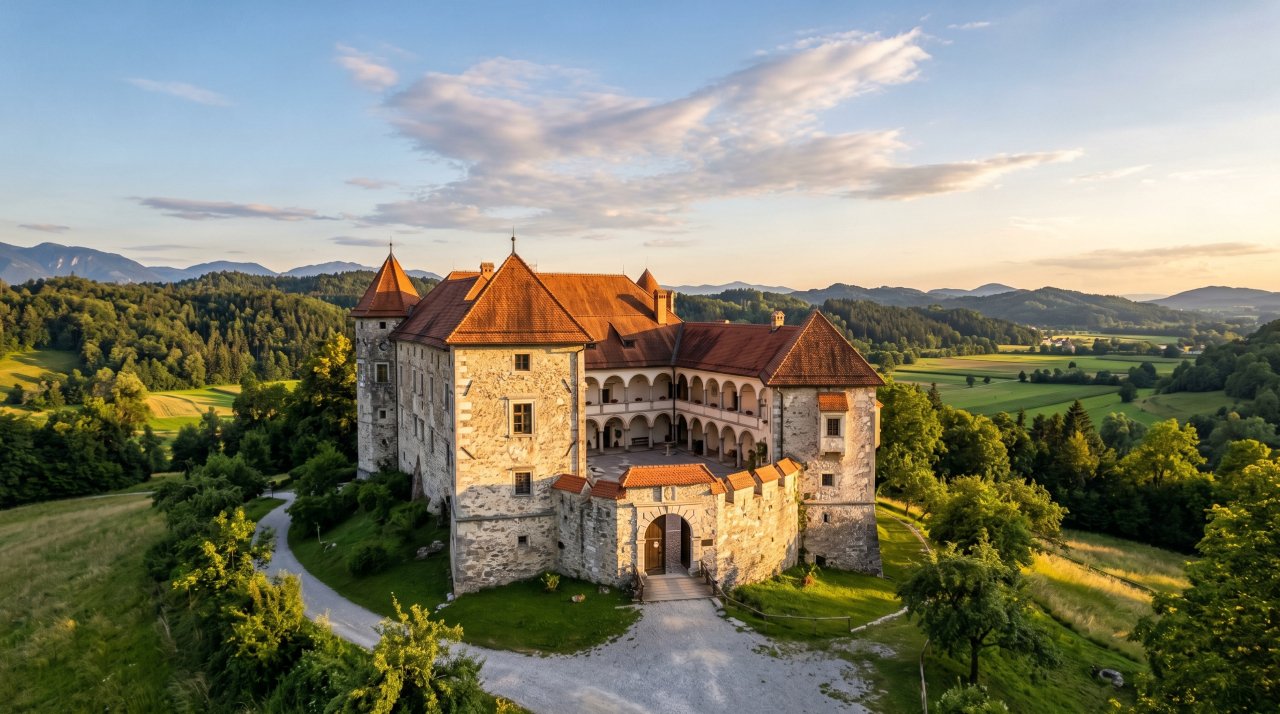
Slovenia has more than 1,000 castles and castle ruins, making it one of the most castle-dense countries in Europe per square kilometer. Most visitors never go past Ljubljana Castle. That is a mistake, especially when a fully restored Renaissance castle with surviving 18th-century frescoes sits just 10 km away.
Jablje Castle, also known as Jable, is one of the most complete and historically rich castles in central Slovenia. It survived wars, neglect, and centuries of ownership changes. It still holds original frescoes painted by one of Slovenia’s most celebrated Baroque artists. A natural spring flows on the grounds next to it.
This article covers the history of Jablje Castle, what makes its frescoes rare, how to get there, and what to expect when you arrive. If you are planning any time in Ljubljana, this is the side trip worth making.
What Is Jablje Castle and Where Is It?
Jablje Castle sits in the village of Loka pri Mengšu, in the foothills of the Kamnik-Savinja Alps in central Slovenia. It is roughly 10 km northeast of Ljubljana, which makes it one of the closest historic castles to the capital. The drive takes about 15 to 20 minutes.
The castle is also called Jable or Jable Manor in older records. Both names refer to the same site. The full name, Jablje Castle, is used in most current tourism and heritage references.
From the outside, the structure is a rectangular Renaissance building with a stone arcaded courtyard, restored towers, and thick walls. It does not look theatrical or over-restored. It looks like a real building with real age, which is exactly what it is.
The grounds include a natural spring adjacent to the main structure. The surrounding landscape is farmland and forest edge, quiet and green, very different from the tourist density around Ljubljana Castle.
The Real History Behind Jablje Castle
Built by Slovenian Nobility in the 16th Century
Construction on Jablje Castle began in the early 1500s. The original owners were the Lamberg family, one of the most prominent aristocratic families in the Duchy of Carniola, the historical region that covers most of present-day Slovenia.
The design reflects Renaissance thinking: symmetry, an open arcaded courtyard, and decorative stonework. This was not primarily a military fortress. It was a residence built to show wealth and permanence. The Renaissance style was fashionable among Central European nobility at the time, and the Lambergs built accordingly.
The location was deliberate. Loka pri Mengšu sat on a productive agricultural plain with access to water, trade routes, and proximity to Ljubljana, which was the administrative center of Carniola.
Ownership Changes Across Three Centuries
The castle passed through multiple noble families between the 16th and 19th centuries. Each family made some mark on the property, through renovations, art commissions, or expansions of the estate.
The most significant artistic contribution came in the 18th century, when the interior was decorated with frescoes by Franc Jelovšek. That commission alone sets Jablje Castle apart from most other manor houses in the region.
By the 19th century, the castle’s importance as a noble residence had faded. The aristocratic system weakened across the Habsburg Empire, and properties like Jablje lost their central social function. Use of the building became more limited and the structure began to deteriorate.
Decline and Restoration in the 20th Century
The 20th century was hard on Jablje Castle, as it was on many Slovenian heritage sites. The building fell into serious disrepair during and after the World Wars. By mid-century, the structure needed major intervention to survive.
A careful restoration project in the latter part of the 20th century brought the castle back to its Renaissance form. Restorers worked to preserve surviving original features rather than replace them. The frescoes received particular attention. The result is a building that feels genuinely old because it is, not a reconstruction dressed up to look historical.
Today Jablje Castle is used for cultural events, private functions, and guided visits. The restoration means the building stays actively maintained, which protects both the structure and the art inside it.
The Frescoes Inside Jablje Castle Are the Real Reason to Go
The most important feature of Jablje Castle is the surviving frescoes by Franc Jelovšek, painted in the 18th century. Jelovšek lived from 1700 to 1764 and was one of the most significant Baroque painters working in Slovenia during that period.
His work is characterized by large-scale wall and ceiling compositions with dramatic figures, vivid color, and the sense of movement typical of the Baroque style. He worked on churches, chapels, and noble residences across the region. His commissions at Jablje represent some of the finest secular Baroque painting still visible in Slovenia.
What makes the Jablje frescoes rare is survival. Many comparable fresco cycles in Slovenian castles were destroyed during conflicts, damaged by moisture over centuries of neglect, or simply painted over by later owners with different tastes. Jablje’s frescoes came through largely intact. The restoration work stabilized them and made them accessible to visitors.
The scenes depict religious and mythological subjects, which was standard for aristocratic interiors of the period. The color palette is warm and rich, and the figures are painted with the kind of confidence that marks an artist working at the height of his ability. Standing in a room with original 18th-century frescoes on the ceiling, in a building that was already 200 years old when Jelovšek painted it, is a genuinely unusual experience.
For anyone interested in Slovenian art history, Baroque painting, or simply beautiful old buildings, the frescoes alone justify the trip from Ljubljana.
The Natural Spring Next to Jablje Castle
Adjacent to the castle grounds is a natural spring that has been part of the site for as long as the castle has stood. Natural springs near noble estates were common in this part of Slovenia. They served practical purposes for the household and the estate’s agricultural operation, and they also carried symbolic value as signs of a good and productive land.
The spring still flows today. It sits close enough to the main building to visit as part of the same stop, and the area around it is green and calm. After spending time inside looking at frescoed ceilings and stone walls, walking out to the spring gives the visit a natural and unhurried close.
The combination of a restored Renaissance castle, intact Baroque frescoes, and a functioning natural spring in one small site is genuinely uncommon. Most heritage sites this size offer one of these things. Jablje offers all three.
What You Can Actually See and Do at Jablje Castle
The interior is the main draw. The frescoed halls are the highlight, and a guided tour is the best way to see them properly. Guides provide context on the history, the Jelovšek paintings, and the restoration work. Without a guide, you will see the rooms but miss much of what makes them significant.
The courtyard is one of the better-preserved Renaissance arcaded courtyards in Slovenia. The stone arcade running around the interior perimeter is intact and photogenic. It gives a clear picture of how the castle would have functioned as a residential compound.
The grounds and spring take roughly 20 to 30 minutes to walk at a relaxed pace. The natural spring is a short distance from the main building. The surrounding landscape is quiet farmland and tree lines, a strong contrast to anything you will find in central Ljubljana.
Events and access are worth checking before you go. Jablje Castle hosts weddings, cultural events, and private functions. On those days, public access to interior areas may be limited or blocked entirely. Check current availability before planning your visit.
| Feature | Details |
|---|---|
| Castle Type | Renaissance manor |
| Built | Early 16th century |
| Location | Loka pri Mengšu, Slovenia |
| Distance from Ljubljana | ~10 km |
| Notable Art | Franc Jelovšek Baroque frescoes |
| Natural Feature | Adjacent natural spring |
| Best For | History lovers, architecture fans, day trippers |
Getting to Jablje Castle from Ljubljana Is Simple
By car is the easiest option. Drive northeast from Ljubljana on the A1/E57 motorway toward Kamnik, then follow signs for Mengeš and Loka pri Mengšu. The total drive from central Ljubljana takes 15 to 20 minutes. Parking is available near the castle grounds.
By bus, regional services connect Ljubljana to Mengeš. From Mengeš, a short local bus or taxi ride gets you to Loka pri Mengšu. The full journey by public transport takes roughly 40 to 50 minutes depending on connections.
By bicycle, the Ljubljana to Kamnik cycling corridor passes through this region and the terrain from Ljubljana to Mengeš is mostly flat. For cyclists who want a day out, the route is manageable and the destination is worth it.
A useful addition to the trip is a quick stop in Mengeš itself, which has a small historical center and sits directly on the route. Adding it adds very little time and rounds out the day nicely.
When Is the Best Time to Visit Jablje Castle?
Spring (April to June) and early autumn (September to October) are the best times to visit. The grounds are green and the weather is comfortable for walking outdoors. The landscape around the castle looks its best during these months.
Summer brings clear skies but also a higher chance of encountering private events that limit interior access. If you go in summer, morning visits reduce both the event risk and the heat.
Winter visits are quiet and the stone architecture looks striking in grey light. Some interior areas may have shorter hours in colder months. The spring and exterior grounds are accessible year-round in dry weather.
The one consistent rule regardless of season: check current opening hours and event bookings before you travel. The castle’s dual function as a heritage site and event venue means access can vary more than at a standard museum.
How Jablje Castle Compares to Other Castles Near Ljubljana
Ljubljana Castle is the most visited castle in Slovenia and is worth seeing. It is also crowded, heavily commercialized, and more of a tourist destination than a historical experience. Jablje Castle is the opposite: quiet, authentic, and focused entirely on the history and art of the building.
Snežnik Castle in southern Slovenia is another beautifully preserved castle with intact period interiors, but it is over an hour from Ljubljana. Bogenšperk Castle in the Litija region is a comparable Renaissance structure but again requires more travel time.
For visitors who want a genuine Renaissance castle with surviving Baroque frescoes and a natural setting, within 20 minutes of Ljubljana, Jablje is the strongest available option. It does not try to be a theme park. It is a real castle with real history, and that is exactly what makes it worth the trip.
Here is why Jablje Castle stands out among Ljubljana day trips:
- One of the few fully restored Renaissance castles this close to the capital
- Authentic surviving frescoes by a named, historically documented artist
- Natural spring on the grounds adds a rare natural feature
- Low crowds compared to Ljubljana Castle
- Active maintenance through event use keeps the building in good condition
Practical Tips Before You Visit Jablje Castle
Check current opening hours before you go. Hours shift based on season and private event bookings, and the castle website or local tourism contacts are more reliable than third-party listing sites.
Book a guided tour in advance if you want full access to the frescoed rooms. Walk-in access may be limited depending on the day. A guided tour gives you the frescoes, the courtyard, and the historical context in one visit.
Wear comfortable shoes. The courtyard has uneven cobblestones and the grounds outside are natural terrain. Photography is generally allowed in the exterior and courtyard. Ask staff about rules for the fresco rooms before photographing inside, as policies for historic painted surfaces can be specific.
Bring cash as a backup. Card payment may not always be available at smaller heritage sites. The combination of entry fee and a small purchase adds up, and it is better to arrive prepared.
Plan for at least two hours if you want to see the interior properly, walk the grounds, and visit the spring without rushing.
Jablje Castle Is Worth Your Time
Jablje Castle gives you three things in one stop: a fully restored 16th-century Renaissance castle, authentic Baroque frescoes by Franc Jelovšek that survived when most comparable works did not, and a natural spring in a quiet countryside setting. It sits 10 km from Ljubljana and takes 15 minutes to reach by car.
This is not a rebuilt replica or a commercial attraction dressed up in history. It is a real castle with real art, maintained because people still care about what it contains. That makes it rare, and that makes it worth your time.
If you are spending more than one day in Ljubljana, add Jablje Castle to your itinerary. Check current opening hours, book a guided tour in advance, and go in the morning before any event setup begins. You will leave with a better understanding of Slovenian history, a close look at genuine Baroque painting, and a visit that most tourists in Ljubljana will never know they missed.
